

A pediatric dietitian sees $47 an hour at Children’s Health in Dallas, multiplies by 2,080, lands on $97,760, and decides that beats the staff job she has now. Clinicians make that exact calculation, and it falls apart on the first low-census morning.
A $47 per diem rate is a spot-market fee for unburdened clinical labor, not a salary floor. When a health system buys care by the hour, it is not offering you a career. It is buying operational elasticity and moving benefit liability, cancellation risk, and malpractice exposure onto your personal ledger. The headline rate is the easiest number in the offer. It is also the only one most clinicians look at.
The Contingent Divide in Clinical Compensation
In clinical work, the line between an hourly wage and an annual salary is the line between contingent labor and institutional backing. In the clinical listings we compiled for this analysis, every hourly one was contingent — per diem, contract, part-time, or internship. Every salaried one but one was permanent and full-time. Hospital finance departments do not mix those mechanisms by accident. We work through the other side of that threshold in Six More Hours a Week Can Leave You Poorer.
Putting a role on an hourly scale insulates payroll from fixed overhead. The $47 ceiling for a Pediatric Dietitian at Children’s Health reads as competitive against staff scales, and it is — until census drops on the pediatric floor. Then the per diem dietitian is called off first, with no recourse and no income for that shift. The rate is elevated precisely because the facility contributes nothing to your long-term security.
Further down the scale the terms get harder, not softer. A lead medical assistant role paid $25 to $32 an hour on a contract. A laboratory technician position ran $24 to $30 on a fixed term. Those rates buy immediate bedside execution and strip out the institutional backing that permanent staff never has to think about.
What Drops Off the Ledger
Bureau of Labor Statistics data on hospital workers puts the scale of this plainly. Employer compensation costs in private-sector hospitals averaged $66.22 per hour worked in March 2026, of which wages were $43.51 and benefits $22.71 — benefits running roughly 34% of total compensation, or about half again on top of wages. That is the layer a per diem conversion removes. A fraction of it comes back to you as a higher hourly rate. Most of it does not come back at all.
- Health coverage and the hour threshold: Under the Affordable Care Act (Internal Revenue Code § 4980H), Applicable Large Employers — those with 50 or more full-time equivalent employees — must offer minimum essential coverage to staff averaging at least 30 hours per week or 130 hours per month. Contingent schedules are frequently written to sit under that line. Ask where yours is capped and get the answer in writing.
- Paid leave: Permanent clinicians accrue two to four weeks. Per diem and contract clinicians accrue none. Two weeks of vacation and one week of illness at $47 an hour is $5,640 of gross income you simply do not earn.
- Retirement match: Staff positions commonly carry a 3% to 5% employer match on a 401(k) or 403(b). Contingent workers forfeit it entirely, and forfeit the compounding along with it.
- Call-off exposure: Staff clinicians typically have guaranteed minimums or float rights. Per diem workers can be canceled with as little as two hours’ notice, after you have already arranged childcare and driven in.
Run the comparison rather than assuming it. Against a $38 staff rate, the $47 per diem premium is $18,720 a year. Subtract $5,640 for the three unpaid weeks. Subtract roughly $7,200 for an individual marketplace plan at $600 a month. Subtract about $3,160 for the 4% match you no longer receive. What survives is roughly $2,700, and a single canceled twelve-hour shift each month erases that and more. The premium is a self-insurance buffer, and it is thinner than it looks, not extra income.
Malpractice Exposure Is the Part Nobody Reads
Permanent hospital employees work under the facility’s umbrella policy. When a staff nurse or medical assistant faces a suit or a board inquiry, risk management runs the defense and the institution absorbs the settlement.
For contract and per diem personnel that coverage gets murky, and the murk is not accidental. Many vendor management agreements require contingent clinicians to carry personal professional liability. Even where a facility extends baseline coverage, it is written to protect the facility’s interest. If something goes wrong, the health system’s counsel is working to insulate the health system, and your license is not on their list.
Do not step onto a unit under a contract or per diem agreement without your liability profile in writing. Ask whether the facility’s policy is occurrence or claims-made, and whether licensure defense is included. If it is claims-made and there is no tail policy at termination, you need to buy your own tail — otherwise a claim filed after you leave finds you personally.
The same argument applies to nurses moving into remote clinical work, for the same reason: the coverage that matters is the coverage that answers to you. We lay out the full case in The Silent Ward. Independent policies for RNs and most allied health roles run roughly $100 to $300 a year — advanced practice licenses cost considerably more. Whatever your license, it is the cheapest line in your entire contingent setup and the only one that protects the thing you cannot replace.
The Divide, Listing by Listing
| Position Title | Facility / System | Location | Posted Pay Structure | Posted Classification | Profile |
|---|---|---|---|---|---|
| Pediatric Dietitian | Children’s Health | Dallas, TX | $34 – $47 / hour | Per Diem | Call-Off Exposure |
| Medical Social Worker | Tampa General Hospital | Tampa, FL | $32 – $42 / hour | Part-Time | Variable Hours |
| Lead Medical Assistant | Penn Medicine | Philadelphia, PA | $25 – $32 / hour | Contract | Fixed Term |
| Laboratory Technician | Moffitt Cancer Center | Tampa, FL | $24 – $30 / hour | Contract | Fixed Term |
| Respiratory Therapy Manager | Select Specialty | San Diego, CA | $105,000 – $135,000 | Temporary | Interim Leadership |
| Telehealth Medical Assistant | Executive Mental Health | Los Angeles, CA | $45,000 – $55,000 | Full-Time | Permanent Staff |
| Chief Nursing Informatics Officer | UChicago Medicine | Chicago, IL | $260,000 – $340,000 | Full-Time | Executive |
Look at the bottom two rows against the top four. A Chief Nursing Informatics Officer mandate at UChicago Medicine reaches $340,000 with full enterprise backing. The Telehealth Medical Assistant role in Los Angeles paid $45,000 to $55,000 — modest money — and still it carries the scheduling stability and coverage access that a $47 hourly rate does not. Nominal pay and employment security are two different axes, and clinicians routinely trade the second for the first without noticing they made a trade.
The Interim Exception
Virtually all temporary clinical work runs hourly. Interim management breaks the pattern. A Respiratory Therapy Manager role at Select Specialty in San Diego carried a fixed $105,000 to $135,000 despite being classified temporary.
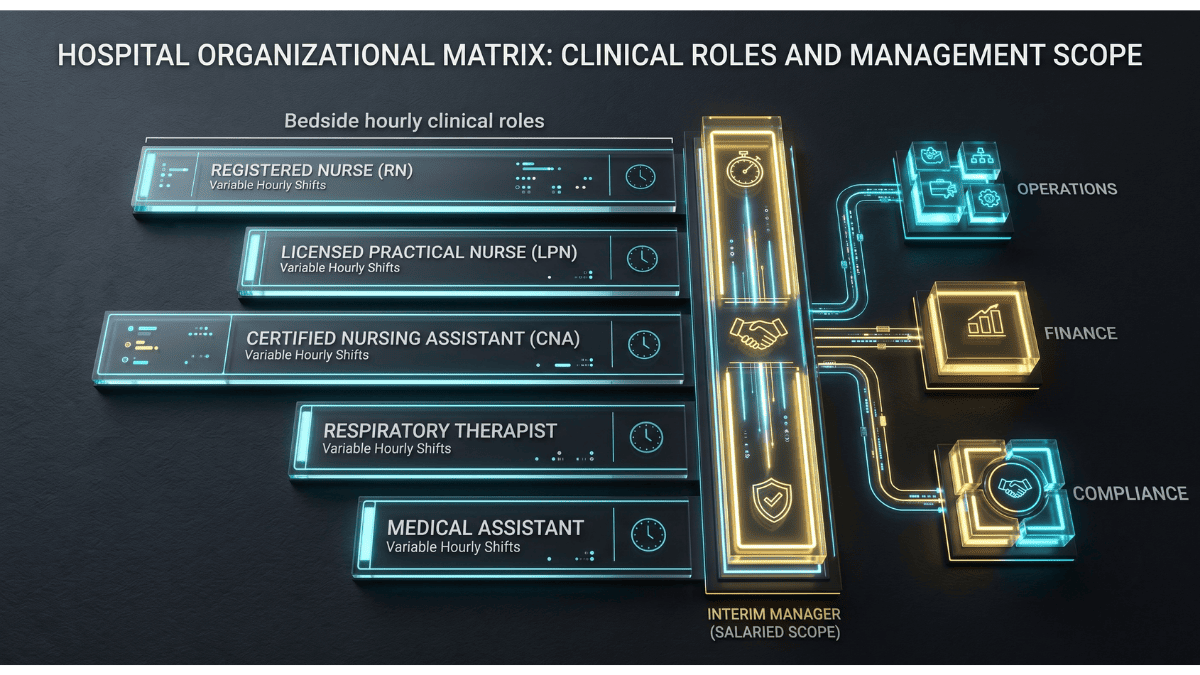
The exception exists because leadership availability cannot be metered. That manager owns regulatory compliance, shift staffing, department budget, and physician relations. When a compliance issue surfaces at two in the morning, the response is the job, not billable by the hour. Facilities pay a fixed rate to buy operational ownership through a transition, not patient-care hours.
If you are being offered interim leadership, price it as leadership. If you are being offered per diem bedside work with a leadership title attached to it, that is a different transaction and it should be paid hourly with everything above audited.
When Contingent Work Is Actually the Right Call
None of this makes per diem a bad decision. Clinicians build excellent careers on it. It works when your household already absorbs what the hospital stopped providing.
- You are covered elsewhere. If a spouse’s plan already covers you, you are not paying for a benefit you would otherwise have to buy. The $47 becomes what it appears to be, and the arithmetic above changes completely.
- You stack deliberately. Experienced clinicians hold per diem status at two non-competing systems and take the premium weekend and night differentials at both. That is a portfolio, and it out-earns a single staff line.
- You are buying your calendar back. Staff clinicians carry mandatory overtime, call rotations, and holiday requirements. Per diem means you decide. For someone leaving burnout behind, that control is the compensation.
What does not work is relying on a single per diem line as sole household income with no secondary coverage and no cash reserve. That is enterprise-level risk for wage-level return. The same structural question — who carries the cost of your independence — runs through our breakdown of fractional contracts, and the answer is identical in both fields.
Five Questions Before You Sign
Recruiters lead with the rate and go quiet on unit-level scheduling policy. Get these in writing before you commit a single shift.
- Where do per diem staff sit in the low-census call-off order? If you are canceled first, calculate how many missed shifts a month your budget survives.
- Is there a weekly hour cap, and what is it? If the cap sits just under 30, understand what that means for your coverage eligibility.
- How much notice do I get on a canceled shift? A two-hour window means you absorb the cost of having prepared.
- Is liability coverage occurrence or claims-made, and who funds the tail? Written answer only. This is the question that protects your license.
- Do night, weekend, and holiday differentials apply to per diem staff? Some facilities exclude contingent workers from differentials entirely, which quietly removes the premium you took the job for.
The clinicians who do well in contingent work are not the ones who found the highest rate. They are the ones who priced what was missing before they said yes. Every listing in that sample states its classification and pay structure — per diem, contract, or permanent, said plainly — and the therapy growth piece shows where the money is moving. A clinical role that hides which one it is deserves the question asked directly.
The same question — what form of appointment is actually on offer — decides the money in settings that look nothing like a hospital: Esports Coach Jobs: Why the Contract Matters More Than the Salary.
Employer compensation costs are Bureau of Labor Statistics Employer Costs for Employee Compensation data for private-sector hospitals, March 2026. Pay ranges quoted from advertisements are as advertised by employers in the sample of listings we compiled for this analysis, at the time of writing; those listings are no longer public. Rules, thresholds and figures attributed to federal sources are as published by the IRS guidance on identifying full-time employees under the Affordable Care Act. Annualizations from an hourly rate use 2,080 hours and are our own arithmetic on the published rate, not an employer projection. Interpretation, comparisons and any figure described as an estimate are our own editorial reading of those sources.

