

The fastest-growing occupations in American healthcare are not nursing and not medicine. They are therapy and behavioural health, projected to grow three to five times faster than the economy as a whole through 2035. Four of the six fastest require a master’s degree at the door. The fifth requires a certificate and opens 109,700 posts a year.
Those two facts describe two entirely different careers, and the choice between them is usually made by accident — by whichever programme a person happened to hear about first.
Where the growth actually is
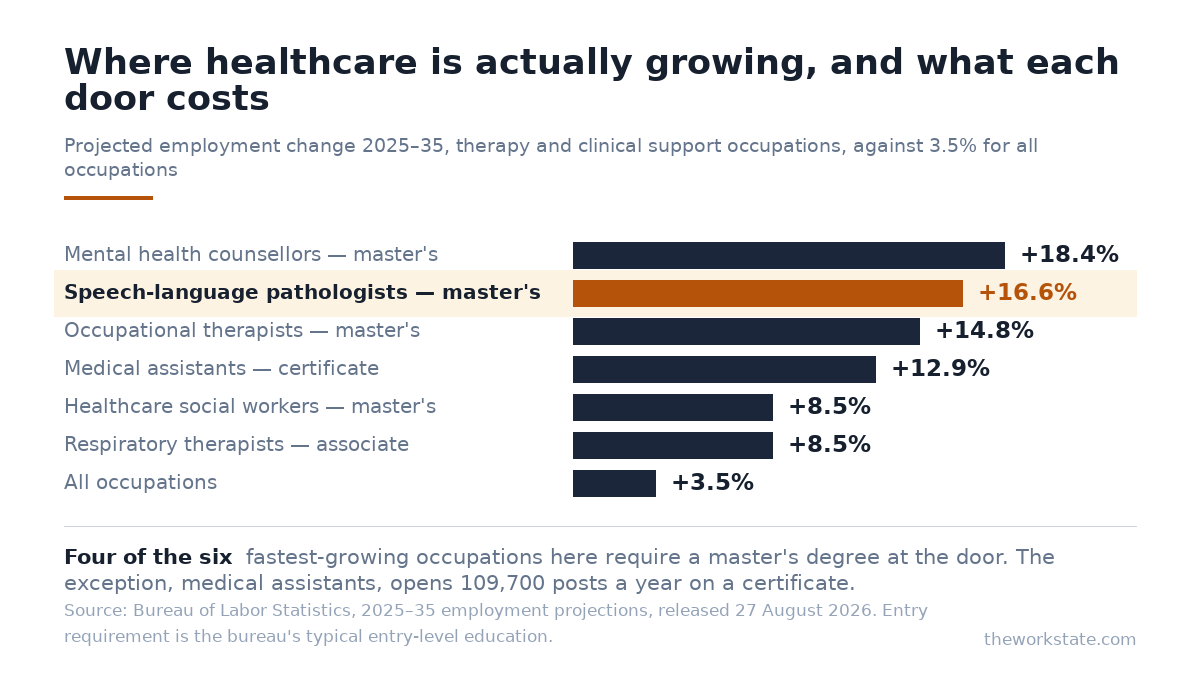
| Occupation | Median wage | Change to 2035 | Openings a year | Typical entry |
|---|---|---|---|---|
| Occupational therapists (29-1122) | $100,330 | +14.8% | 10,000 | Master’s |
| Speech-language pathologists (29-1127) | $97,870 | +16.6% | 12,500 | Master’s |
| Respiratory therapists (29-1126) | $82,280 | +8.5% | 8,600 | Associate |
| Healthcare social workers (21-1022) | $67,880 | +8.5% | 16,900 | Master’s |
| Mental health counsellors (21-1018) | $59,350 | +18.4% | 50,500 | Master’s |
| Medical assistants (31-9092) | $45,690 | +12.9% | 109,700 | Certificate |
The uncomfortable line in that table is the fifth one. Mental health counselling is the fastest-growing occupation on the list, it requires a master’s degree, and it pays $59,350, less than respiratory therapy, which asks for an associate degree. Demand and compensation are not the same signal, and in behavioural health they currently point in opposite directions.
The mental health counsellor post at Pacific Clinics at $78,000 to $98,000 sits well above that median, which is worth knowing: the median describes a national occupation that includes a great deal of lower-paid community and non-profit work.
The credential that actually gates speech-language pathology
People planning a move into speech-language pathology budget for the master’s and stop there. The degree is the smaller half of the requirement.
The ASHA certification standards require a master’s, doctoral or other recognised post-baccalaureate degree, and then a Clinical Fellowship. The fellowship’s structure is where the planning has to happen:
- No less than 36 weeks of full-time professional experience, where full-time means 35 hours a week and a minimum of 1,260 hours.
- You cannot buy your way out with overtime. The standards state that work in excess of 35 hours a week cannot be used to shorten the fellowship below 36 weeks. It is a duration requirement, not only an hours requirement.
- Part-time counts, but has a floor. Anything under 5 hours a week does not count toward the fellowship at all.
- At least 80 percent of your major responsibilities during the fellowship must be direct client or patient contact.
- It must be completed under a qualified mentor, which makes your first employer a credentialing decision rather than only a job decision.
The fellowship is the reason the first post matters more than the second. A role with no qualified mentor, or with less than eighty percent direct contact, does not advance the credential regardless of how good the work is.
There are also clocks. The fellowship must be initiated within 24 months of the date ASHA receives the certification application, and completed within 48 months of initiation. Separately, fellowship experience more than five years old at the time of application will not be accepted. Anyone who steps away mid-route — for caring responsibilities, illness, or a change of plan — should know those windows exist before they need them.
This is the same structural pattern we set out for infection prevention and nursing informatics: in clinical specialisms the qualification that lets you practise is almost never the qualification you were told to get.
Where the three pathology posts sit
The occupation’s wage distribution runs from $62,900 at the tenth percentile to $134,160 at the ninetieth, with a median of $97,870. Against that:
- The paediatric SLP post at Dell Children’s at $78,000 to $102,000 straddles the median.
- The voice therapist post at the University of Miami Health System at $70,000 to $95,000 sits mostly below it, an academic health system post in a sub-speciality.
- The lead SLP post at AMN Healthcare at $105,000 to $125,000 sits entirely above it. AMN is a healthcare staffing organisation, and that premium is the familiar trade: a higher rate against the institutional backing an employer normally carries.
Before treating the third as a raise, run the arithmetic we set out on what drops off the ledger when clinical pay moves from salaried to contingent. Employer compensation costs in private hospitals average $66.22 an hour, of which $22.71 is benefits, roughly a third of the package, and the part that a rate premium has to replace before it is a gain.
The certificate track is not a consolation prize
Medical assistants deserve separate treatment because the numbers are unusual: 833,900 posts today, 941,500 by 2035, and 109,700 openings a year, more than every other occupation in this article combined, several times over. The entry requirement is a postsecondary certificate, not a degree.
The constraint is the ceiling. The occupation’s tenth percentile is $36,050 and its ninetieth is $59,310, a compressed distribution, which is what you would expect from a role defined by delegated tasks. The lead medical assistant post at Penn Medicine at $25 to $32 an hour and the telehealth medical assistant post at Sharp HealthCare at $24 to $31 both sit inside that band.
Treat it as the fastest available entry into clinical work with the shortest path and a hard ceiling, which makes it an excellent first step and a poor last one. The people who do best from it treat the post as a funded vantage point from which to choose the next credential, with the employer’s tuition assistance as part of the compensation.
Before you commit to a programme
- Cost the credential, not the degree. For therapy occupations the supervised fellowship or practicum is the binding constraint, and it has time limits.
- Ask a prospective first employer whether a qualified mentor is on staff and what proportion of the role is direct patient contact. Both are certification questions, not preferences.
- Do not read growth as pay. The fastest-growing occupation here pays the least of the master’s-level roles.
- Ask what tuition assistance exists and what service commitment attaches to it — particularly on the certificate track, where it is the main route upward.
- Price a staffing-agency premium against the benefits it replaces, not against your current salary.
Healthcare’s growth is real and it is concentrated in a handful of occupations that the general conversation about the sector barely mentions. What separates them is not demand — they all have it, but the shape of the door: a master’s plus a supervised fellowship on one track, a certificate and a compressed ceiling on the other. Both are open. They are just not the same decision.
Employment projections, median annual wages, annual openings and typical entry-level education are Bureau of Labor Statistics figures from the 2025–35 projections released on 27 August 2026. Percentile figures are from the May 2025 Occupational Employment and Wage Statistics. Certification requirements are as published by the American Speech-Language-Hearing Association in the 2020 SLP certification standards; state licensure is separate and additional.


