

An ESL coordinator post at a community college pays $52,000. A lead instructional designer post at a community college pays $65 an hour. Both sit inside the same federal occupational code, and the second rate is above the ninetieth percentile for that code while the first salary is below its twenty-fifth. The gap is the form of the appointment, not seniority.
Instructional coordination is one of the few education occupations where the federal data publishes both an annual and an hourly wage distribution. That makes it unusually easy to check whether an offer is good, and unusually easy to see that two offers with the same job family can be describing completely different arrangements.
What the code pays
| Instructional coordinators (25-9031), May 2025 | Annual | Hourly |
|---|---|---|
| 10th percentile | $47,980 | $23.07 |
| 25th percentile | $60,780 | — |
| Median | $77,440 | $37.23 |
| 75th percentile | $98,820 | — |
| 90th percentile | $121,670 | $58.49 |
Now place the three posts on our board against it. The ESL coordinator post at Dallas College runs $58,000 to $72,000. The ESL coordinator post at Miami Dade College runs $52,000 to $68,000. Both start below the occupation’s twenty-fifth percentile of $60,780, and neither top reaches the median.
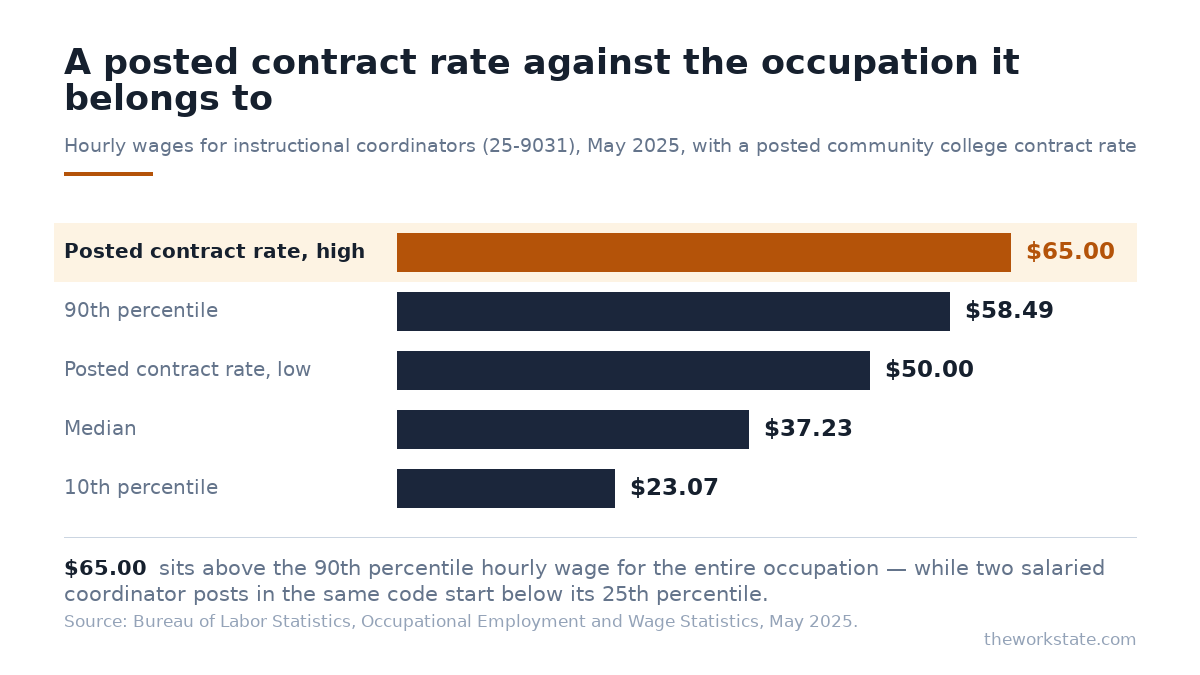
The lead instructional designer post at Austin Community College runs $50 to $65 an hour. The occupation’s median hourly wage is $37.23 and its ninetieth percentile is $58.49. The top of that posted range is above the ninetieth percentile of the entire national occupation.
What the higher rate is actually buying
An hourly rate and a salary are not two ways of saying the same thing, and the difference is rarely the part that gets discussed at interview. A salaried coordinator post at a public institution is an appointment: a defined calendar, a benefits package, a pay scale with steps, and a position that exists after the current project does. An hourly rate is a price for time.
When an institution pays above the ninetieth percentile hourly for work it could hire salaried, the premium is usually paying for something the institution does not want to commit to.
That is a reason to ask rather than a reason to decline. The questions are specific and answerable: how many hours a week are guaranteed rather than available; whether the engagement has an end date; whether benefits attach at any hour threshold; and what happens between terms. We set out the general version of this arithmetic in the piece on offers where the rate is published and the hours are not, and it applies here exactly.
Run the multiplication both ways before you compare the three posts. At forty guaranteed hours a week across a full year, $50 an hour is $104,000, comfortably past the salaried posts. At twenty hours across two fifteen-week terms, it is roughly $30,000. The rate does not tell you which of those you are being offered.
The entry requirement is a master’s degree
The Bureau of Labor Statistics is unambiguous about the door: instructional coordinators “typically need a master’s degree and related work experience, such as in teaching or school administration”. It adds that coordinators in public schools may be required to hold a state-issued licence.
Two consequences follow. First, the K–12 and higher education branches of this occupation have different gates, a community college coordinator post is generally not a licensed position, while a district-level curriculum coordinator often is. Second, the return on that master’s is worth calculating honestly against a starting salary below the twenty-fifth percentile. The degree is the entry ticket, not the raise.
This is the same structural pattern we described for paraprofessional qualification rules: in education, the credential that lets you apply and the credential that improves your pay are frequently not the same credential, and the advertisement discusses neither.
A flat occupation with steady turnover
The 2025–35 projections put instructional coordinators at little or no change — 248,700 posts growing by about 4,100 over the decade — with roughly 23,100 openings a year, most of them replacing people who move on or retire.
That is a stable, mid-sized occupation rather than a growing one. It rewards patience and geography more than it rewards ambition: the posts exist, they turn over reliably, and there are not going to be many more of them than there are now.
Comparing two posts in two states
The Dallas and Miami Dade posts differ by $6,000 at the bottom and $4,000 at the top, which is close enough that the salary is the least useful thing to compare. What separates them is everything the range does not state:
- Is the appointment faculty or staff? At community colleges this determines the calendar, the governance rights, and often the pay scale you progress along. It is rarely in the advertisement and always in the offer.
- Is it twelve months or an academic year? A ten-month appointment quoted as an annual figure is a different number from a twelve-month one at the same salary.
- Who is on the pay scale and where do you enter it? Public institutions usually publish their scales. Find the document before you negotiate; it will tell you the ceiling as well as the floor.
- How many programmes and campuses does the post cover? ESL provision at a multi-campus college is a materially larger job than at a single site.
- Does the institution fund the master’s if you do not yet hold one, and does that carry a service commitment?
Instructional coordination is genuinely good work with a legible wage distribution and a reliable flow of openings. Just read the offer as three separate questions, the form of the appointment, the number of months, and the guaranteed hours, because in this occupation those three answers move the annual figure further than the advertised range ever does.
Wage figures are Bureau of Labor Statistics data for May 2025 under Instructional Coordinators (25-9031); the bureau publishes both annual and hourly distributions for this occupation, and quartile figures are published for annual wages only. Entry requirements and the licence note are the bureau’s own. Employment projections are the 2025–35 projections released in August 2026. Annualisations shown are illustrative arithmetic, not estimates of any specific post.


