

Two years of college, an associate degree, or pass a formal assessment. Every study guide, district FAQ and recruiter repeats that triad as the federal requirement for classroom paraprofessionals. Congress repealed it on 10 December 2015. What binds you now is your state’s rule, and in several states the old federal test survives as state law, administered by the district you are applying to.
This is not a technicality. It changes who you ask, what you can prepare in advance, and whether a qualification you hold travels across a state line. It is also the reason two districts thirty miles apart can give you different answers and both be correct.
What was repealed, and what replaced it
The triad came from section 1119 of the No Child Left Behind Act, codified at 20 U.S.C. § 6319, “Qualifications for teachers and paraprofessionals”. The Every Student Succeeds Act repealed that section outright. The statute page now reads, in its entirety, that it was struck by Public Law 114–95.
What remains in federal law is much shorter. Under 20 U.S.C. § 6312(c)(6), a district receiving Title I funds must ensure that all teachers and paraprofessionals working in a programme supported with those funds “meet applicable State certification and licensure requirements”.
Congress did not lower the bar. It handed the bar to fifty different bodies and stopped describing it. The requirement you must satisfy is now a state question wearing federal clothing.
California kept the old rule in its own statute
California is the useful case, because the special education paraprofessional post at San Jose Unified on our board sits under it, and because the state’s answer is unusually legible.
Under California Education Code § 45330, a district receiving Title I funds must ensure every paraprofessional hired since 8 January 2002 who assists in instruction has demonstrated at least one of the following:
- Completion of at least two years of study at an institution of higher education. The statute sets no subject requirement, the credits do not have to be in education.
- Possession of an associate degree or higher. Again, in any field.
- A local or state assessment, appropriate to the responsibilities to be assigned, demonstrating knowledge of and ability to assist in instructing reading, writing and mathematics.
That is the repealed federal triad, preserved in California law. The statute is still worded “Pursuant to the federal No Child Left Behind Act of 2001”, a reference to a provision that no longer exists. The state requirement outlived the federal one it cites.
The requirement almost nobody mentions
Subdivision (c) applies to Title I-funded posts. Subdivision (e) is broader and is the one that catches people out: no person may be initially assigned to assist in instruction as a paraprofessional in kindergarten through grade 12 at all — Title I or not — unless they have demonstrated proficiency in reading, writing and mathematics at or above the level the employing district requires of its own high school seniors.
Read that carefully, because two things follow from it. The standard is set by the district, not the state. And subdivision (g) requires the district to align that proficiency exam with the assessment route in subdivision (c), so for most candidates the exam is one exam, written locally.
California does not run a statewide paraprofessional test. There is nothing to sit in advance, no national credential to arrive holding, and no way to be qualified before you apply if you are taking the assessment route. You apply, and the district tests you against its own benchmark. Knowing this is the difference between treating a rejection as a verdict on your ability and treating it as one district’s cut score.
Now the pay, and the number that misleads
The San Jose post advertises $24 to $30 an hour. Annualise that the way anyone would — 2,080 hours, a standard working year, and you get $49,920 to $62,400. That is a serious salary for a role requiring no degree.
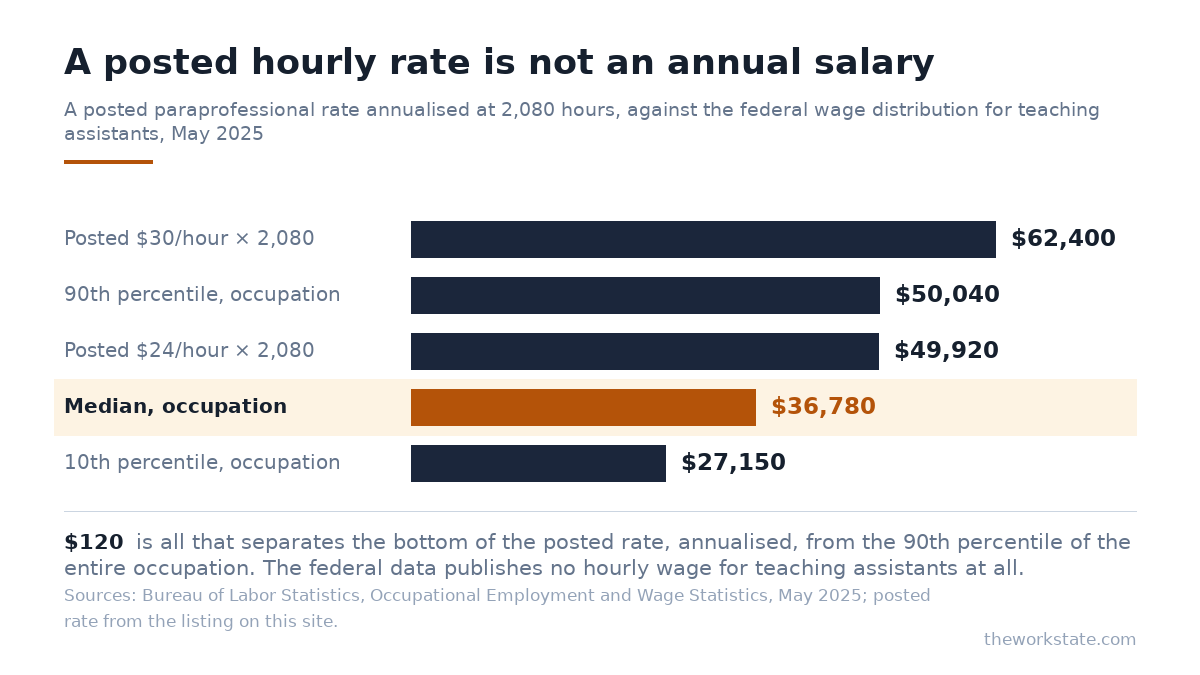
The federal median for teaching assistants was $36,780 in May 2025. The ninetieth percentile was $50,040. So the arithmetic above puts the lowest advertised rate within $120 of the top decile of the occupation nationally, which should tell you the arithmetic is wrong, not that the job is extraordinary.
Two facts explain it. The Bureau of Labor Statistics publishes no hourly wage for this occupation at all — only annual figures, because the hourly number would not describe anything comparable. And the bureau states plainly that teacher assistants “generally do not work during the summer”.
A school-year calendar is not 2,080 hours. Nobody in the hiring process is hiding this; it simply never gets said, because the district quotes an hourly rate and the candidate does the only multiplication they know. Ask for the number of paid days and the daily hours in the assignment, and do the multiplication with those. If the post is under a benefits threshold for part of the year, our piece on how additional hours can leave you poorer covers the second-order problem.
Flat employment, enormous turnover
The 2025–35 projections put teaching assistants at zero percent change, a decline of 4,900 posts against a base of 1,463,000. On its own that reads as a closed field.
It is the opposite. BLS projects about 176,200 openings a year for the occupation, and expects most of them to come from people transferring to other occupations or leaving the workforce. That is one of the highest replacement rates in the American economy, and it is the single most important fact about the job: the door is permanently open because people permanently leave.
For someone who wants classroom experience before committing to a teaching qualification, that churn is an opportunity. For someone treating the post as a destination, it is a warning about what the work does to the people already in it.
Where the ladder actually goes
The move people assume is paraprofessional to teacher. The move the wage data rewards most is paraprofessional to instructional coordinator (25-9031) — median $77,440, more than double the assistant median. The barrier is honest and it is large: the typical entry-level education is a master’s degree, and the occupation is projected to grow only 1.6 percent, with about 23,100 openings a year.
Special education teaching is the nearer step from a special education paraprofessional post, a median of $65,120 at kindergarten and elementary level on a bachelor’s degree, though the projections have that occupation essentially flat too.
Before you apply
- Ask the district which rule it applies, and whether the post is Title I funded. The answer determines whether you face subdivision (c), subdivision (e), or both.
- Ask how many college units the district counts as “two years”. There is no national definition and districts have used both 48 and 60 semester units. This is worth a phone call before you enrol in anything.
- Ask whether the assessment is offered on a schedule and whether you may retake it. It is a local exam, so the answer is local too.
- Get the paid days and daily hours in writing, then compute the annual figure yourself. Do not multiply by 2,080.
- Ask what happens over the summer — whether there is extended-year work, whether benefits continue, and whether you are expected to claim unemployment or find other work.
- If you may move states, ask which route is portable. An associate degree travels. A district proficiency exam does not.
Paraprofessional work is one of the last well-structured entries into a professional field that asks for no degree at the door. The requirements are real and they are meetable. They are simply no longer written where everyone still points, and the pay is a school-year figure wearing an hourly disguise.
The repeal of 20 U.S.C. § 6319 and the current text of § 6312(c)(6) are as published in the United States Code. California requirements are quoted from Education Code § 45330; other states set their own rules and this article does not describe them. Wage figures are Bureau of Labor Statistics data for May 2025 under Teaching Assistants, Except Postsecondary (25-9045); employment projections are the 2025–35 projections released in August 2026. Annualisation at 2,080 hours is shown to illustrate the error, not as an estimate of the post’s pay.
