

Three positions on this board pay nothing at all. All three are almost certainly lawful, and the reason is a seven-factor test published by the Department of Labor that almost nobody entering the workforce has read. It is one page long, it is free, and it is the difference between an education and an unpaid job.
The test matters most to the people least equipped to apply it. An unpaid position is offered to a student, framed as an opportunity, and accepted in about four minutes. Knowing what makes one legitimate takes about ten.
The rule, stated plainly
The Fair Labor Standards Act requires for-profit employers to pay their employees. Interns and students, however, may not be employees at all, and if they are not, the Act does not require that they be paid.
Which one you are is decided by what the courts call the primary beneficiary test. The question it asks is simple: in economic reality, who is getting the benefit — you or the company?
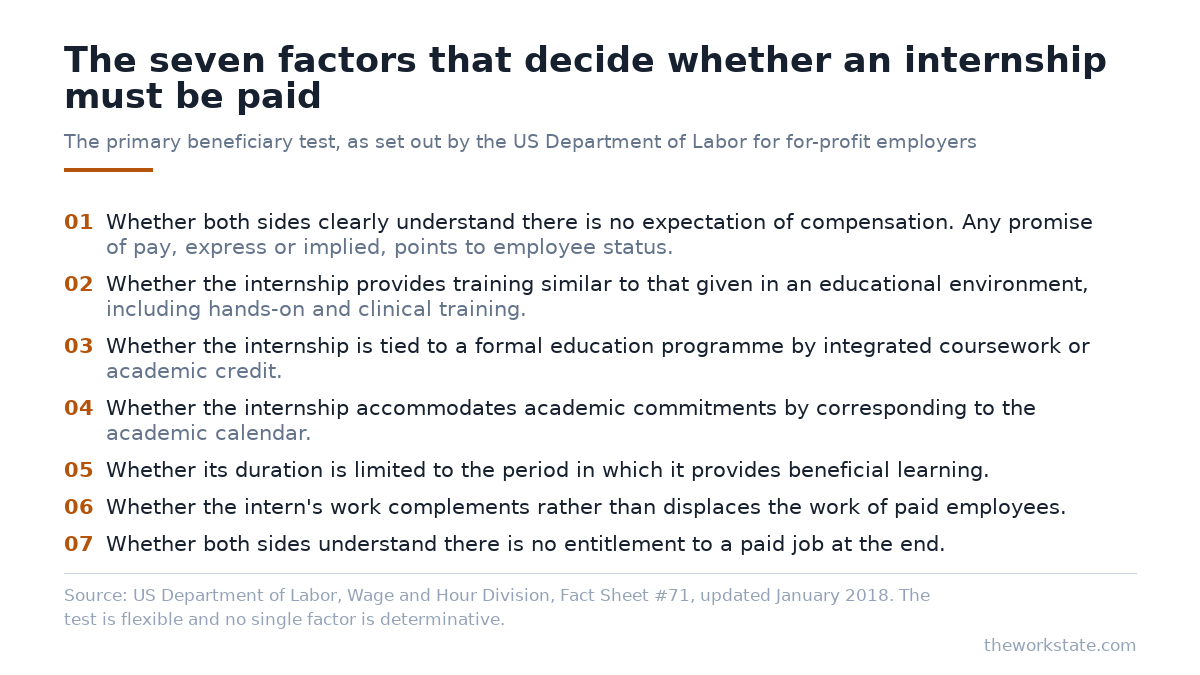
Read factor six twice, because it is the one that does most of the work in practice: whether the intern’s work complements rather than displaces the work of paid employees. An unpaid intern covering a shift that would otherwise have been filled by a paid worker is the classic failing case, whatever the paperwork says.
Why the unpaid roles here hold up
Apply the factors to the three on this board and the pattern is visible.
- The business externship at Maxwell Locke & Ritter is a single day of structured observation at an accounting firm, described in the listing as observation and structured conversation rather than production work. Short duration, no displacement of paid staff, educational in form — factors two, five and six all point the same way.
- The dental hygiene clinical externship at Pima Medical Institute is a supervised clinical placement inside a teaching programme, where hours convert into documented competencies. That is factor three — tied to a formal education programme — in its most literal form, and factor two names clinical training explicitly.
- The administrative volunteer role at City Harvest does not need the test at all. The Department of Labor recognises an exception for people who volunteer without expectation of compensation for charitable or humanitarian purposes at non-profit organisations, and the fact sheet names non-profit food banks specifically.
The seven factors are not a checklist an employer completes. They are the questions a court would ask afterwards, which means they are the questions worth asking beforehand.
What the failing case looks like
Turn the factors around and the shape of an unlawful arrangement is obvious. An unpaid internship at a for-profit company that runs for months rather than a term, is not connected to any coursework, does not track the academic calendar, involves doing the ordinary daily work of the business, and is dangled with hints about a job at the end — that arrangement fails on almost every factor at once.
Note that the last of those, the implied promise of a job, cuts against the employer twice: factor one treats any implied promise of compensation as evidence of employee status, and factor seven asks whether both sides understood there was no entitlement to a paid job. An employer using the prospect of hire to extract free labour is arguing against itself.
Academic credit is not compensation
“You get credit for it” is the most common justification offered for an unpaid position, and it is worth being precise about what it means. Academic credit appears in factor three, as evidence that the internship is tied to a formal education programme. It is one input among seven, not a licence.
It is also frequently a cost rather than a benefit. At many institutions the student pays tuition for the credit hours attached to the placement, so an unpaid internship for credit can mean paying the university for the privilege of working free. That is not unlawful, and it may still be a good decision. It should just be a decision made with the arithmetic in front of you rather than a phrase that ends the conversation.
Where the paid version sits
Co-ops occupy the other end of the same spectrum and they are generally paid, because the structure is built around production work under supervision rather than observation. The architecture co-op at Gensler pays $22 to $28 an hour and the public accounting co-op at BDO USA pays $28 to $35.
That contrast is the practical takeaway. The same field — accounting — offers a one-day unpaid observation and a paid co-op at $28 to $35 an hour, and both are legitimate, because they are different things. The word on the advertisement is not what distinguishes them. The structure is.
Before you accept an unpaid position
- Establish whether the employer is for-profit or non-profit. This single fact decides whether the seven-factor test even applies.
- Ask what you will actually do each day, and whether a paid employee did it last year. That is factor six, in the only form that matters.
- Ask how long it runs and why it ends when it ends. A duration set by the learning is defensible; one set by the company’s workload is not.
- Ask what the credit costs you in tuition, and put that number next to the hours you are giving.
- Get the no-job-at-the-end understanding in writing, unromantic as it sounds. Ambiguity there is the employer’s risk and your disappointment.
- If it is a paid internship, ask about conversion instead, a different question with different answers, which we set out in the piece on which internships convert.
Unpaid work has a legitimate place in professional entry, and the two externships above are examples of it: short, structured, educational, and honest about what they are. The test exists to separate those from the arrangements that use the same word to mean something else. It is published, it is seven sentences long, and reading it is the cheapest protection available to anyone starting out.
The primary beneficiary test and the seven factors are quoted from US Department of Labor, Wage and Hour Division, Fact Sheet #71, updated January 2018, which states that the test is flexible and that no single factor is determinative. The non-profit and public sector exception is described in the same fact sheet. This is general information about a published federal standard, not legal advice; the Department of Labor notes that whether an intern is an employee depends on the circumstances of each case. State law may impose additional requirements.
