

A UX research internship at a large software company pays around fifty dollars an hour. Annualised, that is $104,000. The full-time job it converts into is benchmarked against a federal median of $78,760. Both numbers are correct, and the gap between them explains why so many converted interns feel the offer is an insult.
Internship pay at the top of the technology market is not a preview of the graduate salary, but a recruiting instrument, priced against other internships rather than against the job. Understanding that before you sign is worth more than any portfolio advice.
Conversion is at a five-year high
The number that decides whether an internship was worth taking is the conversion rate, and it is currently favourable. The National Association of Colleges and Employers reports that the conversion rate reached 63.1% for the 2024-25 intern class, the highest in five years, and a climb of nearly thirteen points over the previous year. Acceptance among those offered ran at 88.3%.
Treat that as a market condition rather than a personal probability. Roughly six in ten interns received an offer. The interesting question is what separates the six from the four, because part of it is decided before you start.
The variable you actually control
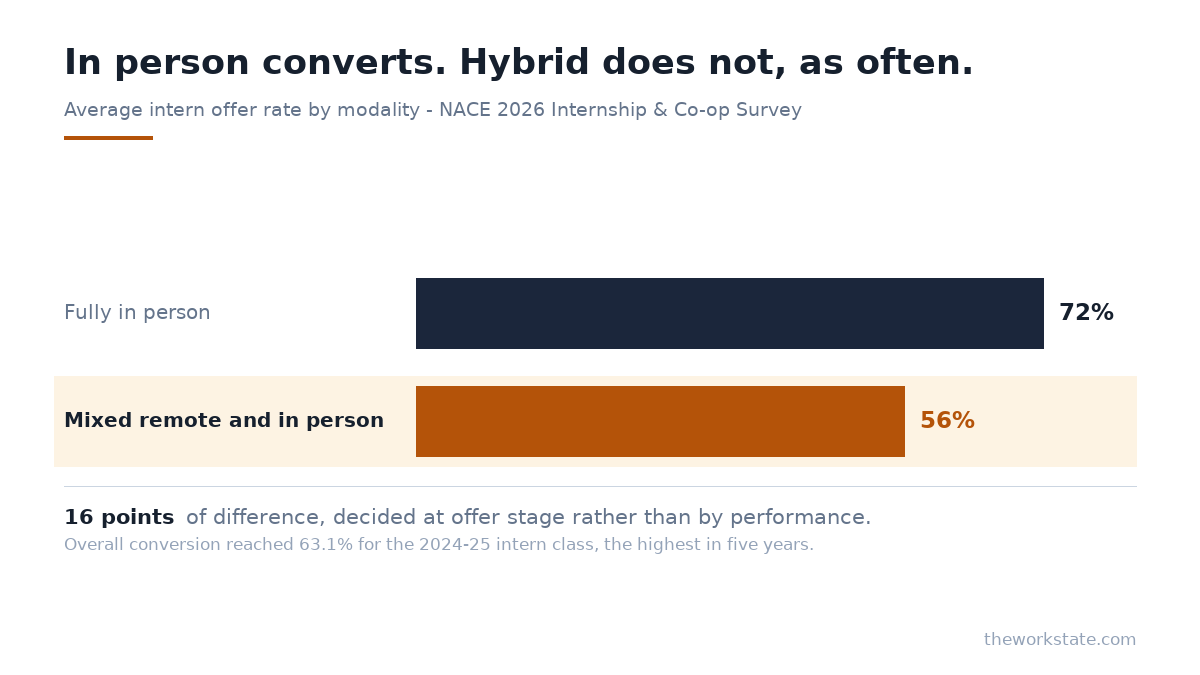
Among the factors NACE measures, one stands out because it is a choice a student makes at offer stage rather than a performance outcome:
| Internship modality | Average offer rate |
|---|---|
| Fully in person | 72% |
| Mixed remote and in person | about 56% |
Sixteen points separate the two, and the gap is about who saw you work, not about productivity. NACE also found that interns who felt well treated were 7.14 times more likely to accept an offer, and those who liked the organisation 6.14 times more likely — relationships that form far more readily in a room than on a call.
If you hold two offers and one is remote, you are not choosing between equivalent experiences. The same dynamic operates on careers already underway, which we covered in the analysis of proximity bias and the promotion gap.
Where the job sits in the federal data
There is no occupational code for user experience research. The role is counted under Market Research Analysts and Marketing Specialists (13-1161), a category of roughly 899,580 people with a median annual wage of $78,760 in May 2025 and projected growth of about seven percent through 2035.
That median is dragged by a very large population doing work unlike yours, so treat it as a floor reference rather than a target. But it is the series a compensation team will consult, and it is why the graduate offer rarely resembles the annualised internship rate. The UX research internship at Adobe on our board pays $45 to $55 an hour. Nothing about that rate obliges the company to open at $104,000 twelve months later, and it will not.
The internship rate is priced against other internships. The graduate offer is priced against the market for the job. Anchoring on the first guarantees disappointment at the second.
What the work is, before the portfolio piece
Research internships at established products are rarely discovery work. On a mature platform the intern’s job is to test assumptions that already exist, run the operational mechanics of scheduling, screening and consent, and produce findings that survive scrutiny from designers who have held their positions for years.
This is worth hearing plainly because the disappointment is predictable. Candidates arrive expecting to shape product direction and find themselves doing recruitment logistics and note synthesis. The ones who convert are usually the ones who treated that unglamorous layer as the actual craft, because it is the part a team cannot delegate to someone they do not trust.
Before you accept the internship
- Ask what the team’s conversion rate has been for the last two intern cohorts. A team that tracks it will tell you; a team that does not track it is telling you something else.
- Ask whether the position is in person, and weigh a remote offer accordingly rather than treating the two as equal.
- Ask who your findings go to. Research that stops at your manager builds no reputation. Research presented to the product team builds one.
- Do not anchor on the hourly rate. Look up what the company’s entry-level researcher band actually is before you form an expectation.
- Ask what happens if there is no headcount. A strong internship at a team with a frozen requisition converts at zero regardless of your performance.
Conversion is at its strongest in five years, and research internships at scale remain one of the few genuine paths into the discipline. Take the in-person one, treat the operational work as the job rather than the tax, and price the graduate offer from the market rather than from your own timesheet.
Conversion, offer and acceptance figures are from the National Association of Colleges and Employers 2026 Internship & Co-op Survey and NACE’s published analysis of conversion factors. Wage and employment figures are Bureau of Labor Statistics medians for May 2025 under Market Research Analysts and Marketing Specialists, the occupational series that user experience research is counted within; there is no separate federal code for the role.

