

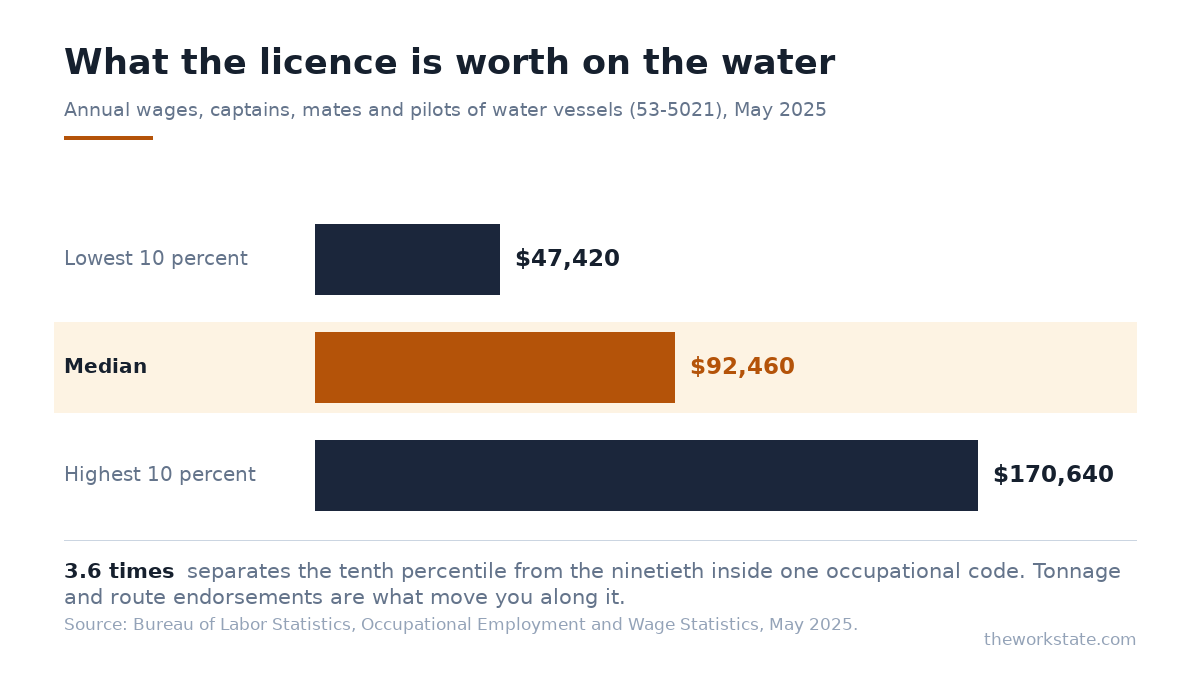
The bottom ten percent of licensed captains and mates earn under $47,420. The top ten percent clear $170,640. Same federal occupation, more than three and a half times the money, and the thing that moves you along that line is what your credential says, not seniority.
Working on the water is one of the few remaining American careers where a document, not a degree, sets the ceiling. That makes the ladder unusually legible, provided you understand what each rung actually costs in time at sea.
The spread, and why it is this wide
| Captains, Mates and Pilots of Water Vessels (53-5021) | Annual wage, May 2025 |
|---|---|
| Lowest 10 percent | under $47,420 |
| Median | $92,460 |
| Highest 10 percent | over $170,640 |
One occupational code covers the harbour launch operator and the tug master moving loaded barges through a commercial port. Federal employment sits at about 41,300 and is projected to reach 42,900 by 2035 in the 2025–35 employment projections — growth of 4.0 percent, close to the rate projected for the economy as a whole. This is not a field that expands its way into promotions, but a credential field, where movement comes from people above you retiring and from you holding a licence that lets you take their seat.
A licence has two dimensions, not one
Deck credentials are described by tonnage and by route, and both restrict what you may command. Tonnage-limited master endorsements are commonly issued at 25, 50 and 100 gross tons. Route is separate: inland waters, Great Lakes, or near coastal, the last extending to two hundred miles offshore, with the operator of uninspected passenger vessels credential limited to one hundred.
Both dimensions are set out in 46 CFR Part 11, which governs officer endorsements, with the credential itself covered in Part 10. Read the actual sections before you commit to a course of study, because commercial training providers summarise them and summaries drift.
Tonnage decides what you can command. Route decides where. An operator with a 100-ton inland ticket and one with a 100-ton near coastal ticket are not competing for the same jobs.
Near coastal costs roughly double the sea time
The structural fact worth planning around is this: for the same tonnage, a near coastal endorsement requires substantially more qualifying sea service than the inland or Great Lakes equivalent — in the published schedules, approximately twice as many days.
That has a practical consequence for anyone accumulating time. Days served on inland routes do not convert into near coastal days. If your intended destination is offshore work, some portion of your sea service has to be earned offshore from the beginning, and a career spent entirely on rivers and harbours will not assemble into a near coastal ticket no matter how many years it runs.
The same logic applies to tonnage. Time on small vessels counts, but it counts more slowly: the schedules require far more days on light tonnage to reach the same endorsement that fewer days on heavier vessels will buy. Choosing the boat is choosing the rate at which your career accrues.
What the top of the range looks like
The ninetieth percentile is not theoretical. The ship captain post at Centerline Logistics on our board runs $135,000 to $185,000 — commercial marine transportation in a major port, which is precisely the segment that sits at the top of this occupation. Those seats require the tonnage, the route endorsement and the documented service behind both.
The distance between that figure and the tenth percentile is a sequence of endorsements and the sea time each one demanded. It is a long ladder, but unlike most career ladders it is written down and the rungs are numbered.
Before you invest in the next endorsement
- Confirm the exact sea service schedule in the regulation, not in a course brochure. The requirement varies by tonnage and by route and the combinations are specific.
- Check whether your accumulated days are on the right route. Inland time does not become near coastal time retrospectively.
- Ask an employer what endorsement their seats actually require before paying for a higher one you will not use, or a lower one that will not qualify you.
- Ask who pays for renewal and upgrade courses. In commercial operations this is often an employer cost and is worth establishing in writing.
- Ask about the rotation. As with other rotational work, the annual figure depends on the schedule as much as the day rate, the same arithmetic we set out for oilfield rotations applies on the water.
Slow employment growth and a pay spread of more than three and a half times describe a field where the licence does the work that a promotion does elsewhere. That is unusually fair, in its way. What it demands is that you plan the credential deliberately rather than accumulating whatever days the current job happens to produce.
Wage and employment figures are Bureau of Labor Statistics data for May 2025 under Captains, Mates, and Pilots of Water Vessels (53-5021); the employment projection is from the 2025–35 projections released in August 2026. Credential structure is governed by 46 CFR Parts 10 and 11; sea service schedules described here are directional and the governing text should be confirmed for any specific endorsement.
