

Translation is the occupation everyone names first when they talk about work that machines have taken. The federal projections released in August 2026 have it growing — slowly, but growing, to 75,400 posts by 2035. What has changed is not the number of jobs. It is what a certain kind of translation work is now priced at.
Both halves of that are worth taking seriously, and they point in different directions for anybody deciding whether to build a career here.
The projection nobody expects
The Bureau of Labor Statistics puts interpreters and translators at 73,900 posts in 2025 and 75,400 in 2035, a rise of 1,500, or 2 percent, which the bureau classifies as “little or no change”. About 6,000 openings a year are projected, most of them replacing people who leave the occupation or retire. The median annual wage was $60,170 in May 2025, and the typical entry requirement is a bachelor’s degree.
That is a flat occupation, not a collapsing one. It is worth holding that against the confident public narrative, because the bureau is the body that has to publish a number and defend it.
Machine translation is not coming. It arrived, and it is in the job description
The more useful thing in the federal data is not the projection. It is how BLS now describes the work itself:
Machine translation software automatically generates text from the source language into the target language, which translators then review in a process called post-editing.
That sentence sits in the occupation’s standard description, alongside the note that nearly all translators use computer-assisted translation tools and translation memories. Post-editing is not a threat on the horizon, but the current shape of the job, already counted inside the 2 percent.
Which means the honest question at interview is not whether the employer uses machine translation. It is what proportion of the role is post-editing output versus producing translation from scratch, because those are different jobs that carry the same title, and, increasingly, different rates.
Where the rate has actually moved
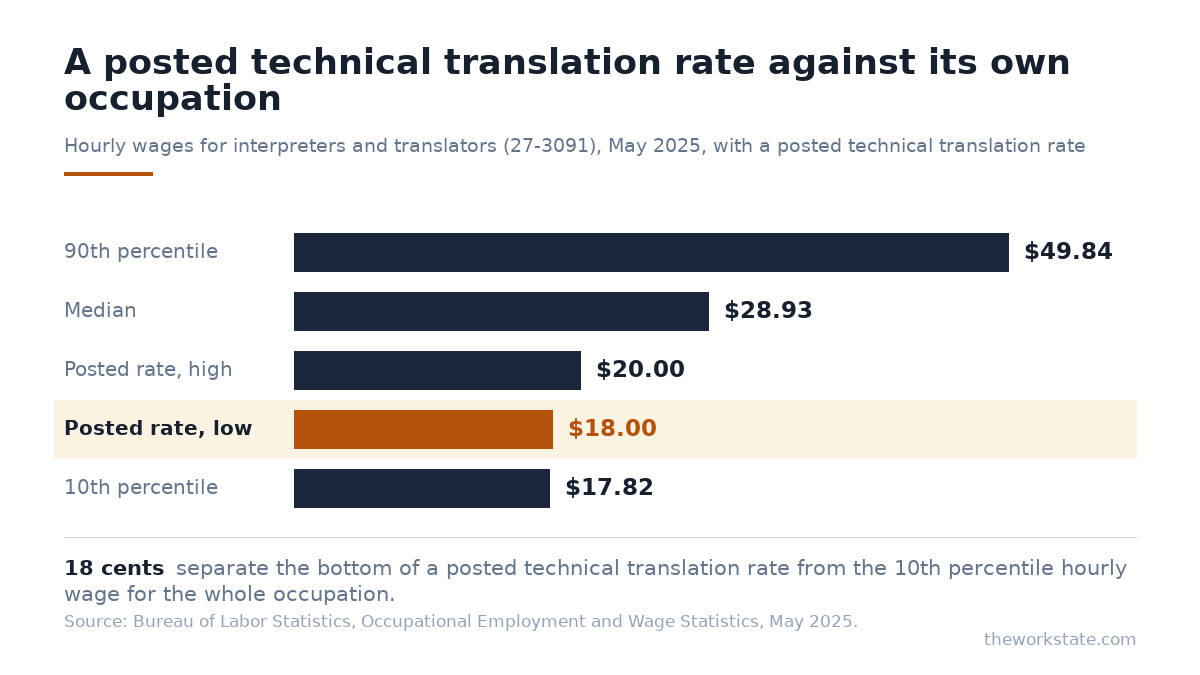
The occupation’s hourly distribution runs from $17.82 at the tenth percentile to $28.93 at the median and $49.84 at the ninetieth. The technical translator post at SAI Interpreting & Translation on our board pays $18 to $20 an hour, which places a role described as technical in the bottom decile of its own occupation.
Compare that with the translator post at TransPerfect at $50,000 to $65,000, which crosses the occupation’s annual median of $60,170. Same occupational code, same country, roughly double the effective rate. The difference is not language pair or subject matter as far as either advertisement discloses, which is exactly why the distribution is worth having in front of you before you answer a rate question.
One code, two different skills
BLS states plainly that “interpreting and translating are different skills: interpreters work with spoken communication, and translators work with written communication”. They are nonetheless counted together under a single occupational code, and every figure above describes the two of them combined.
That matters here more than usual, because the bureau’s description of machine translation appears only in the translator half. Nothing equivalent is said about simultaneous or consecutive interpreting, about courtroom or medical settings, or about sign language interpreting. The published data cannot tell you whether the flat 2 percent is a flat average of two flat halves, or an average of one half falling and another rising, and anyone who tells you which is speculating past what has been measured.
What can be said is that the two halves face different physics. Written output can be generated and reviewed. Spoken interpretation in a hospital or a courtroom is a person in a room under a legal obligation, and the language tutor post at the University of South Florida at $18 to $24 an hour is a reminder that the in-person end of language work has its own pay problem, unrelated to software.
Two employment numbers, and why they differ
The projections count 73,900 people in this occupation. The wage survey counts 52,060. The two are not in conflict: the projections include the self-employed, and the wage survey covers employees of establishments. The gap is a rough indication of how much of this work is freelance, and a reminder that the median wage above describes the employed portion, not the contractor market most translators actually operate in.
Before you accept a rate
- Ask what share of the work is post-editing. Reviewing machine output and producing translation are priced differently and should be quoted differently.
- Ask whether the rate is per hour, per word, or per project, and if per word, whether machine-translated segments and translation-memory matches are discounted. That discount schedule is where the effective rate is actually decided.
- Check the posted rate against the occupation’s own distribution before you negotiate. A “technical” or “specialist” title in the bottom decile is a question worth asking out loud.
- Establish whether you are an employee or a contractor, because most of this occupation is not employed, and the wage figures published for it describe the half that is.
- For interpreting work, ask about certification requirements — court and medical interpreting carry their own credentials, and they are what separate the top of the distribution from the bottom.
The federal data does not support the claim that this occupation is disappearing. It supports something more specific and more useful: the work has been reorganised around reviewing machine output, the title now spans a very wide range of rates, and the published distribution is the only thing standing between you and accepting the bottom of it.
Wage figures are Bureau of Labor Statistics data for May 2025 under Interpreters and Translators (27-3091); employment projections are the 2025–35 projections released on 27 August 2026. The description of machine translation and post-editing, and the statement that interpreting and translating are different skills, are the bureau’s own. Employment counts differ between the two programmes because the projections include self-employed workers and the wage survey does not.


