

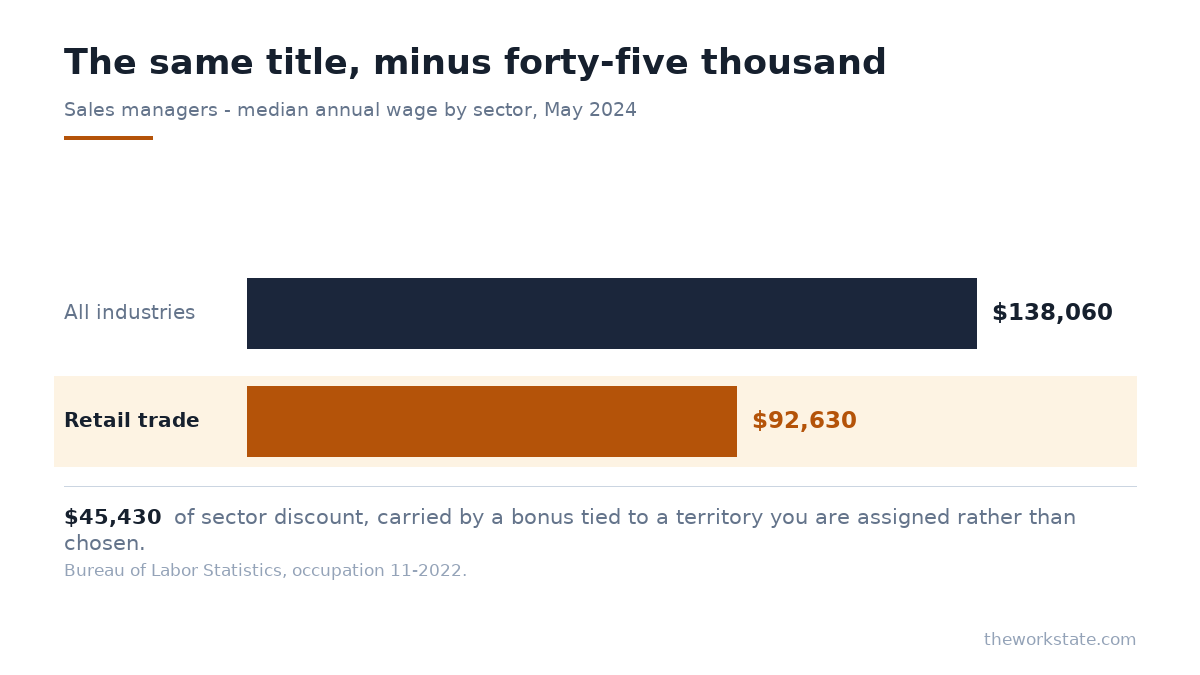
Sales managers earn a median of $148,270 across the American economy. A sales manager at a petrol station chain earns $67,610. One at a car dealership earns $132,250. Same federal occupation code, same job title on the door, and the number that decides which one you are is what the shop happens to sell.
Retail management is discussed as though it were a single market. It is not. Inside retail alone the federal median for this occupation swings by $64,640, which is a larger gap than most people will ever close through negotiation, promotion or performance. Choosing the segment is the highest-leverage decision in the career, and almost nobody treats it as a decision at all.
One job title, nine different markets
| Sales managers (11-2022), median annual wage, May 2025 | Median |
|---|---|
| All industries | $148,270 |
| Motor vehicle and parts dealers | $132,250 |
| Health and personal care retailers | $101,490 |
| Furniture, home furnishings, electronics and appliance retailers | $92,340 |
| Food and beverage retailers | $84,610 |
| General merchandise retailers | $83,790 |
| Clothing, accessories, shoe and jewelry retailers | $83,210 |
| Building material and garden equipment dealers | $82,880 |
| Sporting goods, hobby, book and miscellaneous retailers | $80,570 |
| Gasoline stations and fuel dealers | $67,610 |
Two things are worth reading off that column. The first is that every retail segment sits below the all-industry median, most of them far below, the sector discount is real and it applies whichever aisle you pick. The second is that the discount is not uniform. Motor vehicle retail pays nearly twice what fuel retail pays for the same occupational code, and the distance between the middle segments is small enough that they are effectively one market.
The premium in retail management does not sit with the biggest chains. It sits with the highest-ticket goods, because the commission pool a manager is measured against is a share of transaction value.
That is the mechanism behind the whole table. Where the average sale is a car, the variable component is large enough to lift the median well past six figures. Where the average sale is a tank of fuel, there is nothing for the bonus to be a percentage of, and pay converges on the base.
The strong roles still clear it
Segment sets the median; scope sets the exception. The district manager post at Ross Stores on our board runs $110,000 to $140,000 in general merchandise, a segment whose median is $83,790. Multi-site district management is where retail pays properly, because the role stops being about one store’s takings and starts being about a territory’s economics.
It is also where the performance structure becomes most elaborate, which is the next thing to price.
The bonus is tied to things you only partly control
District and regional management bonuses are calculated against territory performance rather than individual output: comparable sales, profitability, payroll as a percentage of revenue, inventory shrink, and increasingly staff retention. That is a reasonable way to run a business and a difficult way to be paid, because several of those measures are set by decisions made above you.
You will be measured on payroll efficiency in stores whose staffing model you did not design, and on shrink in locations whose layout and security you did not choose. This is why two district managers at the same company, on the same base, can end a year twenty percent apart. The variable is the district, and districts are assigned.
The questions that price the offer properly
- What is the target bonus as a percentage of base, and what did the actual payout average across the district manager population last year? Target and actual are different numbers and only one of them is in the offer letter.
- Which metrics carry the most weight? A plan weighted to comparable sales behaves very differently from one weighted to payroll control.
- Is there a gate? Many plans pay nothing at all below a threshold, which turns a bad quarter into a zero rather than a reduction.
- How is the district composed, and when was it last redrawn? Inheriting four underperforming stores and a vacancy is a different job from the one described in the interview.
- Is the bonus prorated if you join mid-year, and what happens to it if you leave before the payout date?
Where the posted salary is not a salary at all
Adjacent sales roles carry a second problem worth naming: in commission-based positions the advertised range is an estimate of earnings, not a wage. The clearest federal illustration is real estate sales agents (41-9022), where the median is $52,830 and 54.3 percent of the occupation is self-employed. For most of that population there is no employer setting a wage at all; the advertised range describes a distribution of outcomes.
Treat any range on a commission role the same way. Ask what the median actually was and what proportion of new entrants reached it in year one. The gap between advertised range and realised median in commission work is the same mechanic we set out in the piece on hourly offers where the rate is published and the hours are not.
The trade retail actually offers
Retail management remains one of the few paths where someone can reach six figures without a specific degree, on the strength of operational competence and a willingness to be measured. That is genuinely valuable and increasingly rare.
It is also a sector the federal projections expect to shrink. The 2025–35 employment projections published in August 2026 have retail trade losing about 27,500 jobs over the decade as e-commerce continues to limit employment in outlets, even while the sales manager occupation itself grows 4.5 percent on the strength of the segments outside retail. That is a reason to be deliberate about which segment you build a career in, rather than a reason to avoid the sector.
Negotiate the base knowing where your segment sits on the table above, and interrogate the bonus plan as carefully as you would interrogate a salary, because in this sector, that is what it is.
Wage figures are Bureau of Labor Statistics medians for May 2025 under Sales Managers (11-2022), for all industries and by retail subsector; industry names follow the 2022 North American Industry Classification System. Employment projections are from the 2025–35 projections released on 27 August 2026. Bonus structures vary by employer and are not set by any published standard; the questions above are framed for that reason.


