

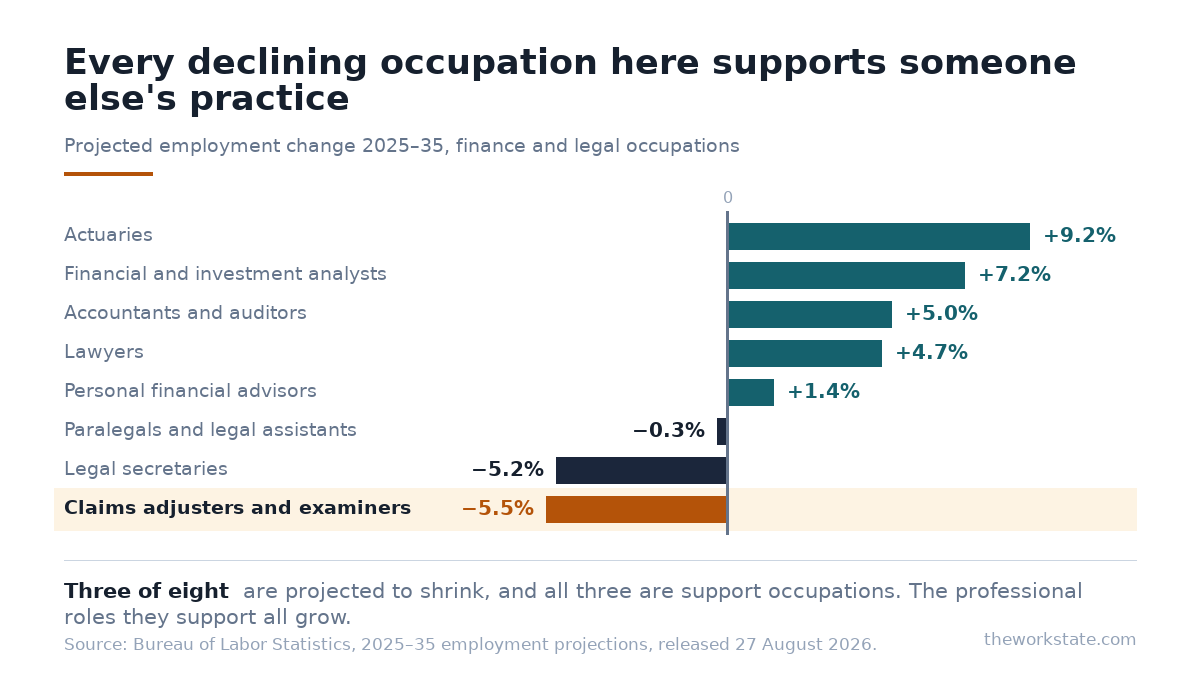
Three occupations in law and finance are projected to shrink through 2035: paralegals, legal secretaries and claims adjusters. Every one of them exists to support somebody else’s practice. Every occupation that is the practice — lawyers, accountants, analysts, actuaries — grows. That is not a coincidence, and it is the most useful thing in the projections for anyone entering these professions.
It is also easy to misread. A shrinking occupation with 40,800 openings a year is not a closed door, but a door that keeps opening into a room that is getting smaller.
The split, in one picture
The support layer
| Occupation | Median wage | Change to 2035 | Openings a year |
|---|---|---|---|
| Claims adjusters, examiners and investigators (13-1031) | $78,000 | −5.5% | 20,900 |
| Legal secretaries and administrative assistants (43-6012) | $55,570 | −5.2% | 18,100 |
| Paralegals and legal assistants (23-2011) | $62,890 | −0.3% | 40,800 |
Claims adjusting is the sharpest of the three: about 20,600 posts removed over the decade, from 376,100 to 355,500. The claims adjuster post at Chubb at $58,000 to $76,000 sits entirely below the occupation’s $78,000 median, which is worth noticing in an occupation the projections mark down. A below-median offer in a shrinking occupation is a specific thing to negotiate about, not a general worry.
Paralegal work is the more interesting case, because the occupation is essentially flat while its ceiling is high. The tenth percentile is $44,740 and the ninetieth is $101,500. The corporate paralegal post at Republic Services at $80,000 to $100,000 reaches close to that ninetieth percentile, a genuinely strong job inside an occupation that is not adding seats. In-house corporate work is where paralegal pay concentrates, and it behaves quite differently from the firm-side average the median describes.
At the other end, the legal transcriptionist post at U.S. Legal Support at $42,000 to $56,000 sits in the part of legal support most exposed to the same pressures we described across office and administrative support, where the bureau names automation tools directly.
The pattern across three sectors this cycle is identical: the work of preparing and processing documents contracts, and the work of deciding what the documents should say does not.
The professional layer, and what the series does not describe
Lawyers are projected up 4.7 percent, from 863,700 to 904,300, with a median of $159,670 and 28,700 openings a year. That is a solid, unspectacular occupation-level picture, and it says almost nothing about the senior roles on this board.
The general counsel post at the San Antonio Fire & Police Pension Fund runs $210,000 to $285,000. The chief IP counsel post at Baker Hughes runs $280,000 to $350,000. The managing partner post at Snell & Wilmer runs $350,000 to $450,000, roughly 2.8 times the occupational median.
This is a general limitation of occupational wage data worth understanding: a median describes the middle of a very large population, and the leadership tier of a profession is a rounding error inside it. Use the series to sanity-check an associate or in-house counsel offer. Do not use it to price a general counsel role, and do not let anyone else use it that way either.
Two roles here have no series at all. The head of decentralised finance post at Jump Crypto at $250,000 to $320,000 and the director of digital assets post at USAA at $175,000 to $215,000 describe work the federal classification does not name. As with the equivalent gap in HR, the practical workaround is to establish which internal band the role was created against, because somebody had to pick one.
Actuaries: the best growth and almost no doors
Actuaries have the strongest projection in this group at +9.2 percent and a median of $130,000, with a ninetieth percentile of $215,100. They are also one of the smallest professional occupations in the country: about 26,670 employed, growing from 31,200 to 34,100 posts, with roughly 1,500 openings a year nationally.
Fifteen hundred openings across fifty states is around thirty a state a year, concentrated wherever insurers and consultancies sit. The pricing actuary post at New York Life at $140,000 to $175,000 sits above the occupational median, which is what you would expect from a large carrier in a major market, and it is one of a very small number of such seats that will exist this year.
Excellent pay, excellent growth, almost no volume. Those two facts should change how you plan rather than whether you enter: it is a career that rewards geographic flexibility and early commitment far more than most.
Where the volume actually is
If the question is simply where the jobs are, the answer in this sector is unglamorous: accountants and auditors, projected up 5.0 percent to a median of $83,680, with 115,300 openings a year, more than every other occupation in this article combined and then some. The public accounting co-op at BDO USA at $28 to $35 an hour is the standard entry into it.
Before you commit
- Separate the practice from the support of it. Every declining occupation in this sector is the second kind. That is the structural question, and it is more important than any single employer.
- If you are in legal support, look at in-house rather than firm-side. The paralegal ninetieth percentile is $101,500 and corporate roles are where it concentrates.
- Do not price a senior role against an occupational median. For leadership positions the series is a floor reference at best and misleading at worst.
- For a small occupation, ask where the seats are before asking what they pay. Fifteen hundred openings a year is a relocation decision.
- Check an offer against the occupation’s own median, not against your last salary, the Chubb range and the Republic Services range sit on opposite sides of theirs.
- If equity forms part of the package, read what actually happens to the withholding before treating the headline number as pay.
Law and finance are not shrinking. What is shrinking is the layer of work that prepares, processes and transcribes on behalf of the people who practise, and the projections are clear enough about it that anyone currently in that layer has a decade of warning and a published list of where to go instead.
Employment projections, median annual wages and annual openings are Bureau of Labor Statistics figures from the 2025–35 projections released on 27 August 2026. Percentile figures are from the May 2025 Occupational Employment and Wage Statistics. Digital asset and decentralised finance roles have no federal occupational classification. The mapping of individual postings to occupational codes is an editorial judgement based on the duties described.

