

Two offers on the table. One pays $21 an hour, the other pays $24. Most people take the $24 and never ask the only question that decides which one is bigger.
The thing nobody tells you about hourly work is that the rate is the number they advertise because it is the number they control. Your paycheck is hours times rate. They publish the rate. They do not publish the hours.
The Rate Is Not the Offer
Run it out over a year and the comparison flips.
| Offer | Rate | Hours per week | Over a year |
|---|---|---|---|
| The one that looks worse | $21.00 | 38 guaranteed | $41,496 |
| The one that looks better | $24.00 | 22, “up to 40” | $27,456 |
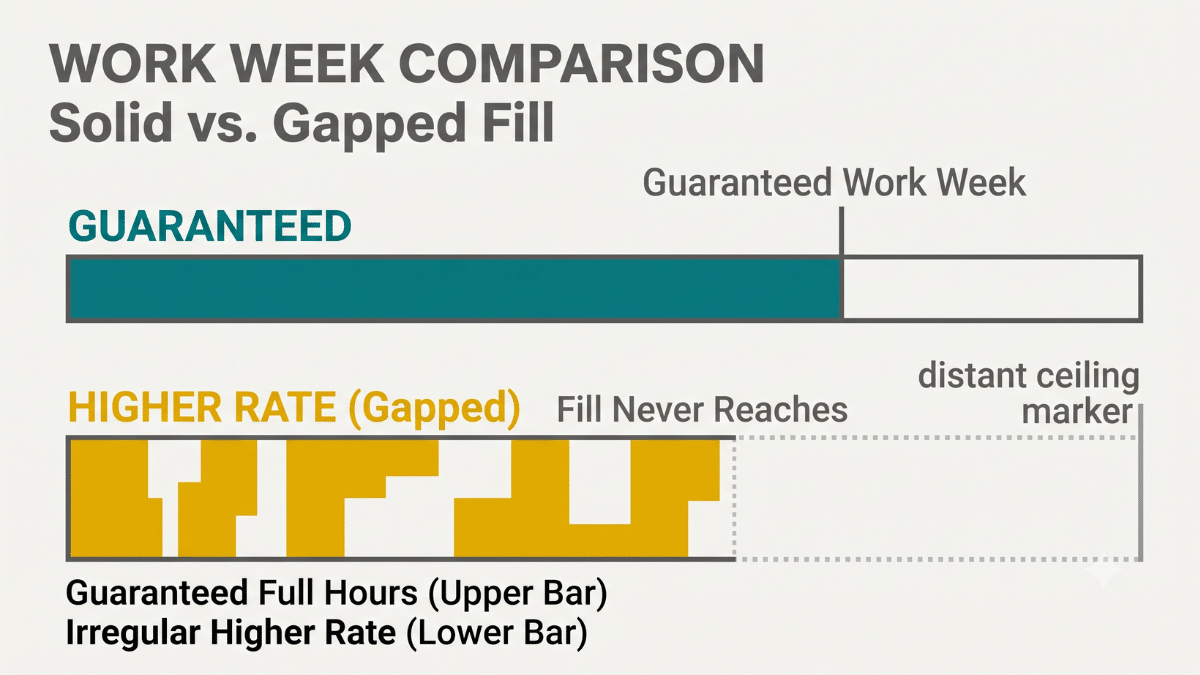
Fourteen thousand dollars, and it went to the lower rate. At $24 an hour you need 33 hours every week just to match what $21 does at 38. If the schedule runs at 22, you are not close.
“Up to 40” is not a promise. It is a ceiling with no floor under it. A week where the store is slow, the census drops, or the job gets rained out is a week where your rent does not change and your check does. On $21 an hour, a 38-hour week pays $798. A 29-hour week pays $609. Nobody called that a pay cut, but that is what landed in the account.
So the first question is not what does it pay. It is how many hours am I guaranteed, in writing. If the answer is a shrug, you have learned something more useful than the rate.
“Full-Time” Does Not Mean What You Think
In the listings we compiled for this analysis there was a student admissions ambassador paying $10 to $11 an hour, listed as full-time. An apprentice electrician at $15 to $16, full-time. A floor technician at $17 to $21, full-time.
And there is a Fraud Analyst at Charles Schwab at $30 to $38 an hour, listed part-time. A Medical Social Worker at Tampa General at $32 to $42, part-time.
Full-time on a job posting is a scheduling label. It is not a legal category and it does not automatically come with anything. What actually determines whether you qualify for the employer’s health plan is hours: under federal rules, large employers must offer coverage to people averaging at least 30 hours a week or 130 hours a month (IRS guidance on identifying full-time employees). A schedule that sits just under that line is a schedule with a reason.
Ask it plainly. Am I benefits-eligible at this schedule, and at how many hours does that start? Get the number, not the adjective.
What Comes Out of Your Pocket
The rate is gross. Before taxes, some employers take more, and here is where people accept things they do not have to.
Under federal wage law, deductions for uniforms, tools of the trade, or cash and inventory shortages cannot bring your pay below the minimum wage, and cannot cut into your overtime (DOL Fact Sheet #16). If a uniform is required — by the employer, by the nature of the work, or by law — its cost and upkeep is the employer’s business expense, not yours to absorb down to nothing.
That does not mean no deduction is ever legal. It means there is a floor, and plenty of people are pushed under it because nobody told them the floor exists.
- Uniforms and required gear. Ask who buys it and who replaces it when it wears out. Boots, tools, and a shirt with a logo add up in a way the rate never shows.
- Training. Ask whether orientation and required training are paid at your regular rate. Unpaid training hours are a real cost and they happen most often in the first two weeks, when you are least likely to argue.
- Certification and licensing. If the job requires a card, a license, or a renewal, ask who pays for it and what happens if you leave before a certain date. Some agreements claw it back.
- Getting there. Multi-site work — cleaning, security, home health, field service — often means driving between locations. Ask whether that time is paid and whether mileage is reimbursed. Between sites is usually work time. Home to the first site usually is not.
Is the Differential Already in That Number
Night, weekend, and holiday premiums are worth real money on an hourly job, and federal law does not require any of them. There is no statute setting a night rate. It is entirely employer policy, which means it is negotiable and it means the posting can present it however it likes.
So when you see $24 an hour on a role that runs overnight, find out whether that is the base rate with the differential on top, or the base plus differential presented as one number. Same posting, two very different offers, and the difference shows up on your first check either way.
Ask what the base rate is, what each differential adds, and which shifts qualify. If the differential is worth two or three dollars an hour and you are working nights anyway, that is the raise nobody makes you ask for twice. We take the night premium apart in Nights Pay More Until You Take a Day Off, including the hours where it quietly stops applying.
Find Out Who Actually Employs You
A good share of hourly work runs through a staffing agency or a contract, and on a job posting that is easy to miss. The name on the listing is the place you show up. It is not always the name on your check.
This is worth knowing on day one because it decides who you go to when something goes wrong. Wrong hours on your check, a missed break, an injury on the floor, the site supervisor may not be the person who can fix any of it. People lose weeks bouncing between the agency and the site while both point at the other.
Three things to establish before you start. Whose payroll are you on. Who handles it if you get hurt on site. And if the job is contract-to-hire, what specifically has to happen for you to convert, a date, a number of hours, a manager’s sign-off. “We usually bring people on after a while” is not a term. We walk through what the same classification does to clinical workers in The Hidden Costs of Hourly Pay in Clinical Healthcare, and the mechanics carry over to any hourly job with a contract label on it.
Whether Your Schedule Is Protected Depends on the County Line
Here is a right most hourly workers do not know they might have.
Some places require your employer to post your schedule in advance — commonly two weeks — and to pay you extra when they change it after the fact. Add a shift late and you are typically owed about an hour of extra pay. Cut your hours late and you are typically owed part of what you lost. It is called predictive scheduling or fair workweek, and it mostly covers retail, food service, and hospitality.
Where it exists is narrow and specific. Oregon has it statewide. A short list of cities has it locally — New York City, Chicago, Evanston, Philadelphia, Seattle, San Francisco, Berkeley, Emeryville, and Los Angeles city and county among them.

And then there is the other list, the one that matters if you live on it. Several states have passed laws blocking their own cities from enacting these protections at all. Florida is one. So are Georgia, Tennessee, Alabama, Arkansas, Indiana, Iowa, Kansas, Michigan, Ohio, and Wisconsin. In those states it is not that your city has not gotten around to it. Your city has been told it cannot.
Find out which side of that line your job sits on before you build a budget around a schedule. If you are covered, you have leverage the posting never mentions. If you are not, you know that the schedule is entirely the employer’s to move, and you plan for that instead of being surprised by it.
Six Questions, One Phone Call
None of this requires a lawyer or a spreadsheet. It requires one conversation before you accept, and the person on the other end should be able to answer all of it.
- How many hours a week am I guaranteed? Not “up to.” Guaranteed.
- At what hour count do benefits start, and does this schedule reach it?
- Is the posted rate base pay, or does it already include a differential?
- Is orientation and required training paid at my regular rate?
- Who pays for uniforms, tools, and any required certification?
- How much notice do I get for the schedule, and what happens if it changes?
A manager who answers all six in five minutes is running an operation that knows its own numbers. A manager who gets vague on hours has told you what the job is, and told you early enough to keep looking.
And if the work happens on a plant floor, a warehouse, or anywhere with machinery, there is one more record worth pulling before you take it. The employer’s federal safety inspection history is public and free, and we walk through how to read it in Audit an Industrial Safety Record Before Taking the Job. Twenty minutes, and it tells you things no interview will.
Every rate in that sample is published in our breakdown of entry-level titles. That gets you the rate. The hours behind it are the part you still have to ask for, and asking is the same arithmetic they already ran on their side, not being difficult.
Rules, thresholds and figures attributed to federal sources are as published by US Department of Labor, Wage and Hour Division, Fact Sheet #16; the IRS guidance on identifying full-time employees under the Affordable Care Act. Interpretation, comparisons and any figure described as an estimate are our own editorial reading of those sources. Pay ranges quoted from advertisements are as advertised by employers in the sample of listings we compiled for this analysis, at the time of writing; those listings are no longer public.
