

On this board a “trainee” earns $16 an hour part-time at a car rental company and $65,000 to $75,000 salaried at a logistics firm. A “junior” earns $45,000 designing and $90,000 writing backend code. The word is doing no work at all. What it attaches to, the occupation you are actually entering — separates outcomes by nineteen points of ten-year growth.
Early-career vocabulary is the least standardised in the labour market. There is no rule about what may be called a trainee, a co-op, a junior post or a fellowship, and employers use whichever word makes the arrangement sound like the thing the candidate wants. The only reliable way to read one of these offers is to ignore the title and identify the occupation on the other side of it.
Where the entry roles actually lead
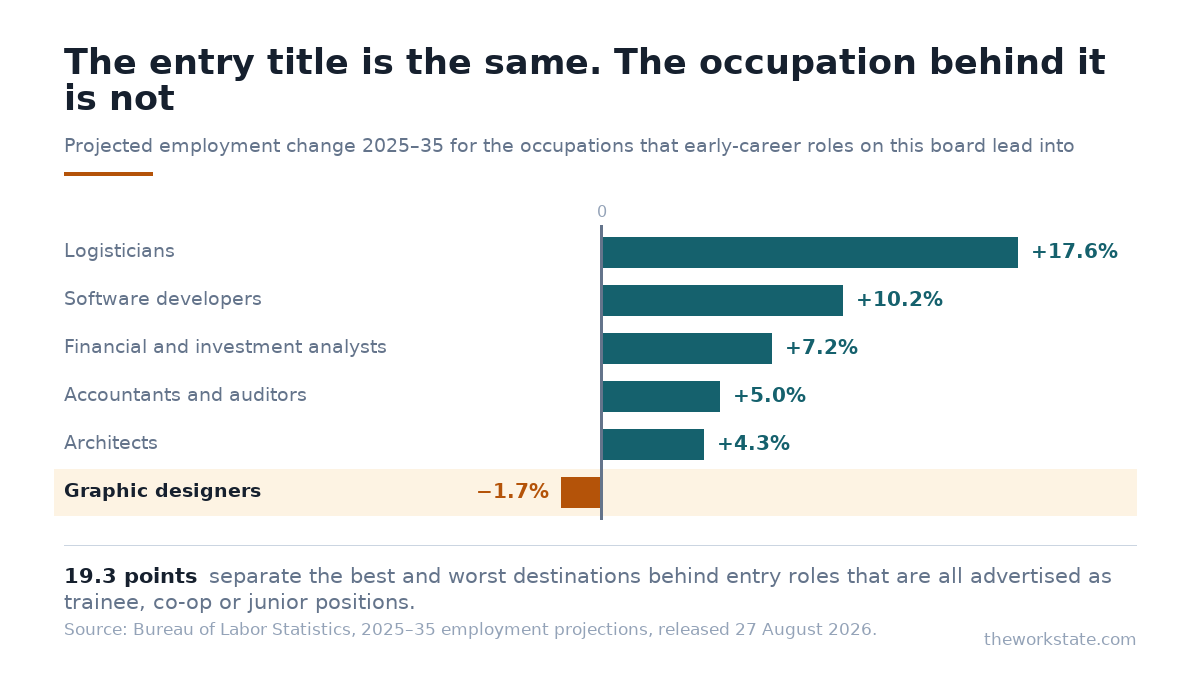
The logistics management trainee post at Ryder at $65,000 to $75,000 leads toward logisticians — projected up 17.6 percent to 2035, with a median of $82,320 and 26,600 openings a year. The junior graphic designer post at URBN at $45,000 to $55,000 leads toward graphic designers, projected down 1.7 percent with a median of $62,960.
Both are legitimate entry roles at real employers. They are not equivalent bets, and nothing in either advertisement says so.
Four arrangements, one vocabulary
The management trainee programme
A structured rotation intended to produce a supervisor within a defined period. These vary enormously in what they actually offer, and the hours matter as much as the rate. The sales management trainee post at Enterprise is advertised at $16 to $19 an hour and is part-time, which changes both the income and the speed at which the programme can conclude. Ask how many weeks the rotation runs, what the promotion criterion is, and what proportion of a recent cohort reached it.
The co-op
A paid placement integrated with a degree programme, alternating with study. The architecture co-op at Gensler pays $22 to $28 an hour and the electrical engineering co-op at CenterPoint Energy pays $22 to $30. Co-ops are generally paid precisely because the work is production work under supervision, which is the line the federal test for unpaid internships turns on.
The junior staff post
Not a programme at all, an ordinary job at the bottom of a salary band, with no defined end and no promised progression. The junior backend developer post at $70,000 to $90,000 and the first-year finance analyst post at Citigroup at $70,000 to $85,000 are both of this kind. These are usually the best-paid of the four and carry the least structure, which is a trade rather than a flaw.
The service year
A fixed-term placement in a public or non-profit setting, compensated on a different basis from employment. The AmeriCorps member post at City Year is posted at $22,000 to $26,000 for the year. Before accepting one, establish precisely what is paid, on what schedule, what benefits attach, and what non-cash award exists at the end, because the arithmetic is not the arithmetic of a salary, and the listing is where the specifics must come from.
Four different contracts, four different risk profiles, and one shared vocabulary. The title is the least informative field in the advertisement.
The question that actually sorts them
The useful question is not “is this a good first job”, but “what occupation does this make me, and what do the projections say about it”. That question has a free, published answer for roughly six hundred occupations, and it takes about five minutes.
Two entry roles in the same building can point at occupations moving in opposite directions. A junior designer and a junior developer sit in adjacent teams on similar floors; one occupation is projected to shrink and the other to add 174,700 posts. Neither advertisement mentions it, because neither employer is in the business of telling you about the labour market.
Before you accept an entry role
- Identify the occupation, not the title. Ask what the role is classified as internally, then look up that occupation’s projection and median.
- Establish whether the role has an end date. Programmes and co-ops do; junior staff posts do not. That difference decides whether you should be negotiating a salary or a progression.
- Ask for the promotion criterion in writing if it is a programme, along with what proportion of the last cohort met it and how long it took them.
- Check whether the post is full-time. A part-time trainee programme takes longer to complete and pays less while it does.
- For a service year, ask what is a wage, what is an allowance, and what is an award, three different things with three different tax and cash-flow consequences.
- Do not read the pay as a ranking. The best-paid entry role on this board sits in a mid-growth occupation; the fastest-growing destination is behind a mid-paid one.
There is no bad first job in this list. There are six arrangements wearing three or four interchangeable words, leading to occupations the federal projections treat very differently, and the only person in the transaction with an interest in knowing which is which is you. The entry title is marketing. The occupation is the job.
Employment projections and median annual wages are Bureau of Labor Statistics figures from the 2025–35 projections released on 27 August 2026. Posted pay ranges are as advertised on this board. The mapping from an entry role to an occupational classification is an editorial judgement based on the duties described in each listing; employers classify roles internally and may differ.

