

On 27 August 2026 the Bureau of Labor Statistics published the projections that will govern career advice for the next year, and office and administrative support came out worst of all twenty-two occupational groups: down 4.0 percent, 752,100 jobs gone by 2035. Inside that single number, one admin occupation is projected to lose a quarter of its posts and another to grow.
The headline will be repeated everywhere for months, usually as “admin jobs are disappearing”. That is not what the data says. The group is shrinking, the shrinkage is concentrated, and the difference between being in the falling part and the rising part is a job title you can often change in under two years.
Where the 752,100 actually falls
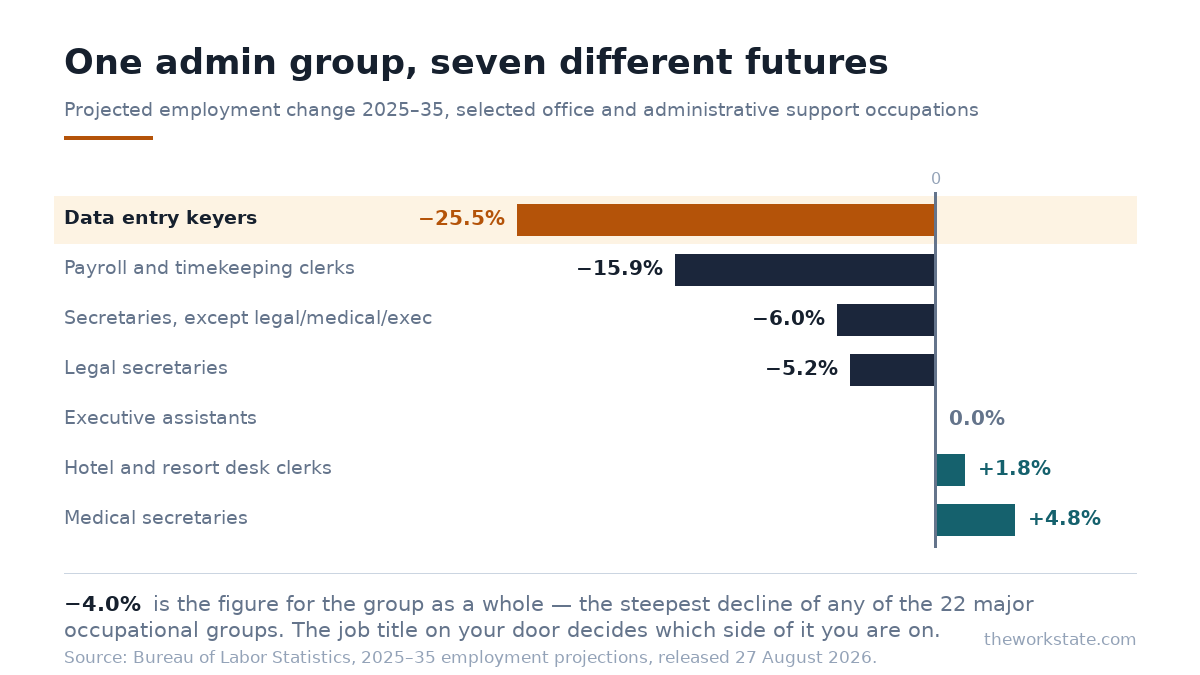
| Occupation | Change, 2025–35 | Median wage, 2025 |
|---|---|---|
| Data entry keyers (43-9021) | −25.5% | $41,340 |
| Payroll and timekeeping clerks (43-3051) | −15.9% | $58,260 |
| Secretaries and admin assistants, except legal, medical and executive (43-6014) | −6.0% | $47,540 |
| Legal secretaries and admin assistants (43-6012) | −5.2% | $55,570 |
| Executive secretaries and executive admin assistants (43-6011) | 0.0% | $76,590 |
| Hotel, motel and resort desk clerks (43-4081) | +1.8% | $35,070 |
| Medical secretaries and admin assistants (43-6013) | +4.8% | $45,930 |
Three of those roles are on this board right now. The data entry specialist post at Memorial Sloan Kettering pays $45,000 to $55,000 and sits in the occupation projected to fall furthest. The senior payroll specialist post at Santander pays $70,000 to $90,000 in an occupation projected to fall 15.9 percent. The executive assistant post at ConocoPhillips pays $85,000 to $105,000 in the one admin occupation the projections leave exactly where it is.
None of those are bad jobs and none of them vanish next year. But they are not the same bet, and the advertisement will never tell you which one you are taking.
What BLS says is driving it
The bureau is unusually direct about the mechanism. In the news release it attributes the group’s decline to “the continued integration of automation tools, including those powered by AI, into workflows”. In the handbook entry for secretaries it goes further and names two separate effects:
Technology, including artificial intelligence (AI) systems and digital tools, enables staff in many organizations to prepare their own documents without the help of secretaries.
And, separately, that many executive assistants now support more than one manager, because managers increasingly do tasks that were previously handed over. Those are two different pressures. The first removes work. The second concentrates the remaining work into fewer, more senior posts, which is exactly what a flat projection and a $76,590 median look like when you see them together.
It is worth being precise about what a projection is. BLS itself asks readers to focus on “the direction and relative size of projected changes, rather than on the precise value estimates”. Minus 25.5 percent for data entry is a strong directional signal. Whether it lands at 24 or 27 is not the point.
A shrinking occupation still hires constantly
This is the part that most coverage of the release will get wrong. Decline is a statement about the number of seats, not about the number of times a seat is filled.
Office and administrative support is projected to lose three quarters of a million jobs and to advertise about 1,727,700 openings a year while doing it. For secretaries and administrative assistants specifically, BLS projects roughly 314,400 openings a year, and notes that all of them are expected to come from replacing people who move to other occupations or leave the workforce.
So the practical reality for someone in admin work is not that hiring stops. It is that hiring continues at volume while the ladder quietly gets shorter, and the competition for each remaining rung gets denser. That is a slower and more disorienting problem than a hiring freeze, because nothing visible happens until you try to move up.
The exits that are actually open
The useful question is not whether to leave admin work, but which adjacent occupations the same projections have growing, and what they ask for at the door.
| Occupation | Change, 2025–35 | Median wage | Typical entry |
|---|---|---|---|
| Training and development specialists (13-1151) | +10.8% | $69,280 | Bachelor’s degree |
| Human resources specialists (13-1071) | +6.4% | $75,940 | Bachelor’s degree |
| Compensation, benefits and job analysis specialists (13-1141) | +6.0% | $78,210 | Bachelor’s degree |
| Medical secretaries and admin assistants (43-6013) | +4.8% | $45,930 | High school diploma |
Two of those are worth separating. Medical secretary is the only growing destination on the list that does not require a degree. It is the lateral move available to someone who cannot stop working to study, and the growth is driven by healthcare demand rather than by anything about the tasks themselves.
Training and development is the opposite: the fastest-growing of the four, a $22,000 premium over the admin group median, and a genuine change of profession. The corporate trainer post at Florida Blue on our board runs $65,000 to $82,000, which is roughly where that occupation’s median sits. If you have spent years writing the process documentation nobody else would write, you have been doing an unpaid version of that job already.
The new AI exposure data, and what it is not
Alongside these projections BLS released something it has never published before: a supplemental table sorting every projected occupation into four categories of relative AI exposure — low, moderate, high and very high — built by combining five outside research measures, three theoretical and two based on observed AI usage.
It is worth knowing this exists, and worth reading the limitations before quoting it at anyone. BLS states plainly that an exposure category “is not a forecast of employment growth or decline”, not a wage forecast, not a probability of adoption, and not a worker replacement estimate. It also notes the underlying research captures AI capabilities as they stood no later than mid-2023.
Treat it as a map of which occupations researchers think overlap with what the technology can do — useful context, not a verdict. The projections above are the number that carries an actual forecast.
If you are in admin work now
- Find out which occupational code your job actually is. “Administrative assistant” covers four federal codes whose projections run from −6.0 percent to +4.8 percent. Your payroll classification is the honest answer, not your business card.
- Ask how many managers the role supports, and whether that number has grown. BLS names consolidation as a driver; a post that absorbed two other posts is telling you where the department is heading.
- Count what proportion of your week is document preparation and data transfer. That is the fraction the bureau expects tooling to absorb. A role that is mostly coordination, judgement and relationships is a different exposure profile from one that is mostly keying.
- Price the degree honestly if you are considering the HR route. Three of the four growth destinations ask for a bachelor’s, and tuition support is a negotiable term of employment more often than people assume.
- Do not treat volume of openings as safety. 1.7 million openings a year in a group losing 752,100 jobs means the door stays open and the room gets smaller.
Administrative work has been the largest single occupational group in the American economy for decades, and it will still employ more than eighteen million people in 2035. It is not disappearing. It is being sorted — into roles that carry judgement and relationships, which the projections leave alone or grow, and roles that mostly move information from one place to another, which they do not. Knowing which one you hold is the whole of the advice.
Employment projections are from the Bureau of Labor Statistics 2025–35 projections, released 27 August 2026, and the accompanying Occupational Outlook Handbook. Median annual wages are the 2025 figures published with those projections. Quoted explanations of the drivers are the bureau’s own. The AI exposure categories are a supplemental BLS product; the limitations described are as published by BLS.

