

There is no national licence for running a childcare centre. Whether you qualify to direct one is decided entirely by the state you are standing in, and the job advertisement almost never says which combination it needs.
This is the reason experienced centre staff apply for director posts and get filtered out without explanation, and the reason candidates move across a state line and discover their qualification no longer counts. It is a solvable problem, but only if you look up the rule before you apply rather than after.
The degree buys down the experience
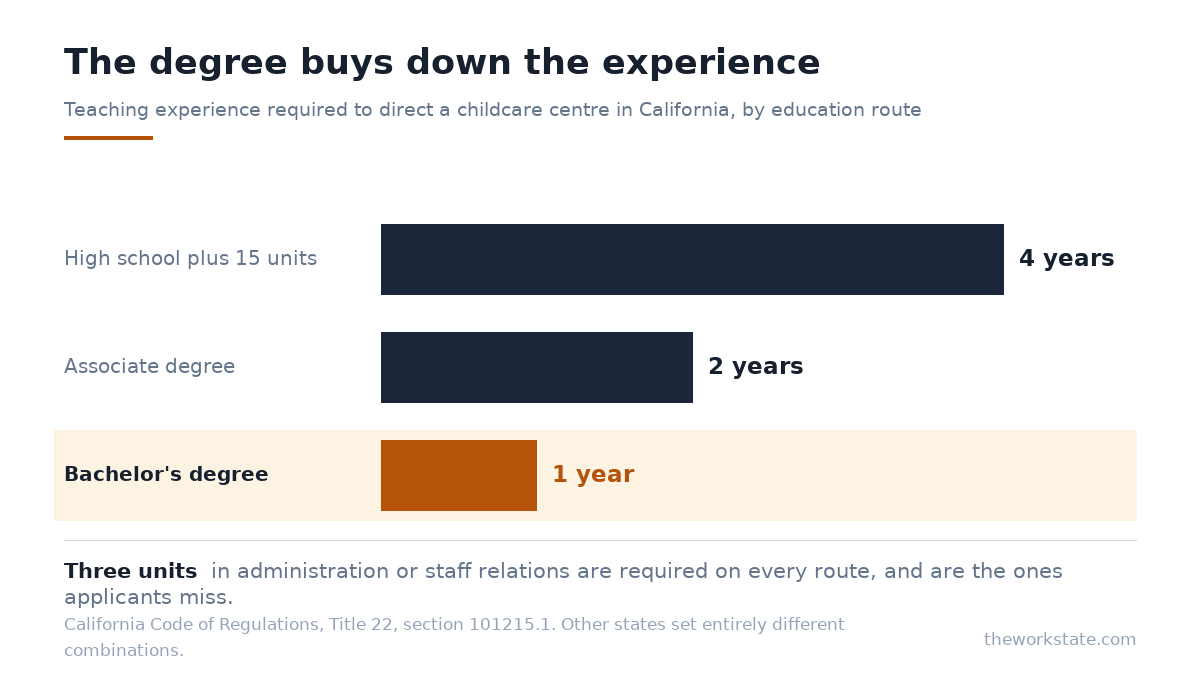
California is a useful worked example because its rule is written plainly. Under Title 22, section 101215.1, a childcare centre director must satisfy one of four routes before employment:
| Education | Teaching experience required |
|---|---|
| High school diploma or GED, plus 15 semester units, three in administration or staff relations, twelve across child growth and development, child and family, and curriculum | 4 years |
| Associate degree with an emphasis in early childhood education or child development, plus three units in administration | 2 years |
| Bachelor’s degree with an emphasis in early childhood education or child development | 1 year |
| Child Development Site Supervisor Permit or Program Director Permit from the state Commission on Teacher Credentialing | as specified by the permit |
Read down that column and the structure is obvious: each step up in education removes a year or two of required floor time. Someone with four years of teaching and fifteen well-chosen units qualifies on the same footing as a bachelor’s graduate with one. That is a genuine ladder, and it is invisible from the job posting.
The three units in administration or staff relations are the ones people miss. Years of classroom experience do not substitute for them, and they are the cheapest part of the requirement to obtain.
Cross a state line and the arithmetic changes
Nothing about California’s structure carries over. Other states set entirely different combinations, and some scale the requirement to the size of the centre:
- Missouri — for centres serving up to twenty children, the state accepts twelve months of experience with six college semester credits in child-related courses, or a Child Development Associate credential, or a Youth Development Credential.
- Texas — directors of centres licensed for thirteen or more children must be at least twenty-one, hold a high school diploma or equivalent, and satisfy one of several education-and-experience combinations, including routes built on a CDA or a Day-Care Administrator’s credential.
- Michigan — programme directors must hold at least two semester hours or three continuing education units in childcare administration, or an administrative credential approved by the department.
The Child Development Associate credential recurs across states as a portable route, and it has a defined cost: 120 hours of childcare education plus 480 hours working with the relevant age group. If you expect to move states during your career, that is the qualification most likely to travel with you.
What the post pays
The federal series is Education and Childcare Administrators, Preschool and Daycare (11-9031), with a median annual wage of $59,300 in May 2025. The federal projections published in August 2026 have the category shrinking 3.1 percent through 2035, which makes the credential question sharper rather than softer: fewer posts, and the same state rule deciding who is eligible for them.
The spread above that median is wide and it tracks the operating model rather than the credential. Corporate and employer-sponsored networks pay substantially more than independent centres, and turnaround posts pay more again, the Bright Horizons director role on our board runs $80,000 to $95,000, and reads explicitly as an interim operational assignment at a site under strain. That premium is compensation for difficulty, not a general market rate.
Before you apply
- Find your state’s director qualification rule and read the exact combination, not a summary. It is published by the licensing agency and it is free.
- Count your administration units separately from your child development units. Most rules require both, and applicants routinely have only the second.
- Ask what capacity the centre is licensed for. Several states set different director requirements above and below a threshold.
- Ask whether the post is permanent or a turnaround. Interim assignments at struggling sites pay well and end on a schedule.
- If you may move states, ask which of your qualifications are portable, a CDA usually is, state-specific coursework often is not.
Directing a centre is one of the few management roles reachable without a bachelor’s degree, provided you assemble the pieces the state actually asks for. The requirement is not hidden. It is simply published somewhere other than the advertisement you are reading.
California requirements are as set out in Title 22 of the California Code of Regulations, section 101215.1. Missouri, Texas and Michigan requirements are as published by their respective state agencies and are summarised here — confirm the current text with the agency before relying on it. Wage figures are Bureau of Labor Statistics medians for May 2025; the employment projection is from the 2025–35 projections released in August 2026.

