

Two universities advertise for an esports coach in the same month. One offers the high twenties with a room and a meal plan. The other offers seventy thousand and a twelve-month contract. Same title, same games, same conference. The difference is not the coaching. It is the appointment.
Collegiate esports is now a staffed department at hundreds of institutions, and the hiring has outrun the vocabulary. The advertisements all say “coach”. Behind that word sit four different employment structures that pay differently, last differently, and end differently. Almost none of the postings tell you which one you are being offered.
Where the job sits in the federal data
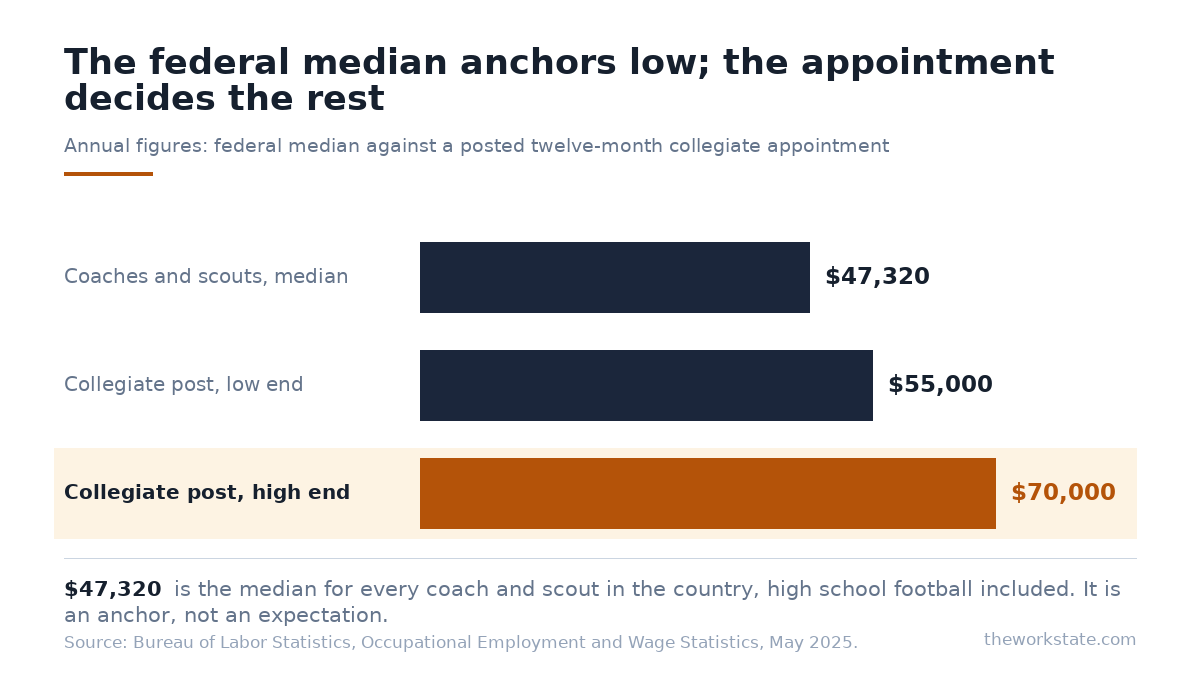
There is no federal occupation code for esports. The role is counted under Coaches and Scouts (27-2022), alongside every high school football coach and club swim instructor in the country. That category had a median annual wage of $47,320 in May 2025, across roughly 248,950 people, and the Bureau of Labor Statistics projects about six percent growth through 2035.
Use that number as an anchor, not as an expectation. It tells you the shape of the wider occupation. It tells you almost nothing about the specific offer in front of you, because within this one title the spread is produced by contract length and by what is counted as compensation.
Four appointments wearing one title
The twelve-month staff line
A full administrative position inside athletics or student affairs. Salaried across the calendar year, benefits from day one, a reporting line, and a budget code that survives a coaching change. This is the version people picture, and it is the least common of the four. The esports coach post at St. Mary’s University on our board sits here, at $55,000 to $70,000 on a full-time basis.
The ten-month academic contract
Paid across the academic year only. The annual figure quoted may look competitive until you notice it covers ten months, and that the summer is unpaid unless you pick up camps or orientation work. Ask whether the salary is annualised or contract-total — those are different numbers and both get quoted as “salary”.
The graduate assistantship
A stipend attached to enrolment. Often includes tuition remission, which is genuinely valuable and genuinely not cash. It ends when the degree does, and it does not build the kind of employment history that transfers to a staff line elsewhere.
The stipend on top of another job
The most common arrangement at smaller institutions, and the one that causes the most trouble. Someone in admissions, IT or residence life picks up the esports program for an additional few thousand dollars a year. The hours are not additional. They are absorbed. If the posting describes the role as “in addition to existing duties”, that is what it is.
The question that separates the four is not “what does it pay?” It is “how many months, and is anything other than money being counted as pay?”
Housing and meals are compensation, but they are not salary
Live-in arrangements are common in collegiate esports because programs sit close to residence life. A room and a meal plan have real value and they reduce real expenses. They also do not appear on a payslip, do not accrue to retirement contributions, and do not travel with you to the next institution.
There is a second-order effect worth naming: an offer built on housing plus a modest cash salary sets a low base for every future negotiation, because the next employer asks what you earned, not what you were given. If you take that trade, take it knowingly and for a fixed period.
The job is recruitment and academic compliance
Institutions did not build varsity esports for the trophies. They built it because it recruits students who would not otherwise apply, and it retains them once they arrive. That is the business case, and it is what the role is measured against.
In practice this means your week is weighted toward eligibility checks, grade monitoring, travel logistics, admissions events and parent conversations. Scrim time is the smaller part. A candidate who arrives expecting to be a tactician and finds themselves running a study hall is not the victim of a bait and switch — they read the wrong half of the job description.
If your background is competitive rather than academic, the transition worth preparing for is the same one described in our piece on what entry-level actually means across four different structures: the title is stable, the underlying arrangement is not.
Before you accept
- Ask how many months the contract covers, and whether the quoted figure is the contract total or an annualised equivalent.
- Ask what portion of compensation is non-cash — housing, meals, tuition remission, and confirm what appears on the payslip.
- Ask where the position sits: athletics, student affairs, admissions or academic. The department determines who defends the budget line when enrolment targets are missed.
- Ask what the program is measured on. If the answer is enrolment and retention rather than results, your performance review will follow admissions, not the scoreboard.
- Ask what happens to the role if the program pauses. A stipend disappears quietly. A staff line requires a process.
Collegiate esports has produced real jobs with real benefits, which was not true five years ago. It has also produced a large number of arrangements that look like jobs and function like favours. The title does not tell you which one you are being offered. The contract does, and it will answer plainly if you ask it plainly.
Wage and employment figures are from the Bureau of Labor Statistics for Coaches and Scouts (27-2022), the occupational category under which collegiate esports coaching is counted; there is no separate federal code for esports. Appointment structures described here are drawn from posted roles and vary by institution — treat them as questions to ask rather than as standards to expect.

