

You have the metrics. You have the operational track record. But the moment you open your mouth in an executive interview, you sound like a textbook.
Most candidates treat an interview like a legal deposition: you are asked a question, you provide a linear answer. This is functionally correct, but commercially dead. In brand strategy, the operating principle has always been the same: stakeholders don’t buy features; they buy narratives.
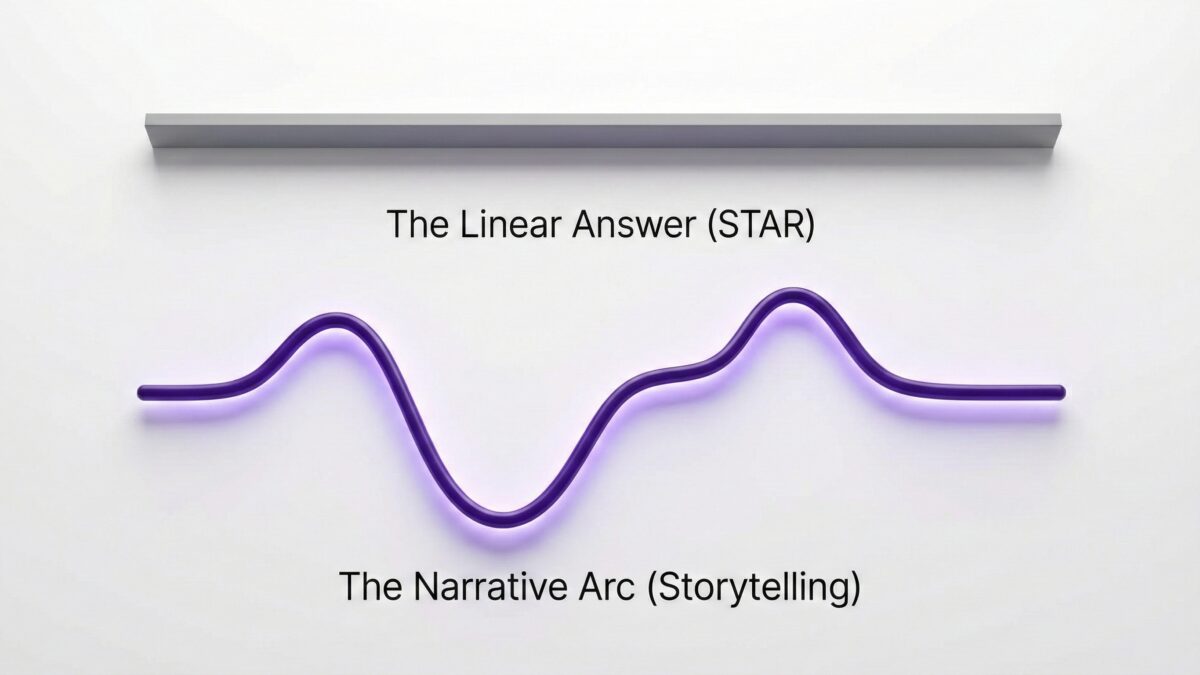
If you’re still relying on the rigid STAR Method (Situation, Task, Action, Result) for every response, you’re commoditizing yourself. Whether you’re negotiating a C-Suite executive package or fighting for a Director role, you must stop acting like a candidate and start positioning yourself as a premium asset.
Before we go further, a caveat you are owed, because bad advice on this point can cost you an offer. STAR is not worthless. It is the floor. Structured interviewing has expanded rather than receded, a growing share of companies now score behavioral answers against an explicit competency rubric, and in those rooms the interviewer is literally checking whether you stated a situation, an action, and a measurable result. Skip the Result and you lose points, no matter how compelling your narrative was.
So the instruction is not “abandon STAR.” It is: hit every STAR component, then keep going. The framework is a scoring minimum, not a ceiling on what you are allowed to say. What follows is how you clear the minimum in the first twenty seconds and spend the remaining ninety doing something the other candidates are not.
The Liability of Rehearsed Perfection
We’ve all seen it. A highly qualified professional sits down and, when asked about a weakness, recites a sterilized script about “perfectionism” or “caring too much about the details.”
This is the “Pageant Contestant” syndrome. It’s polished, safe, and completely forgettable. When you sound scripted, you trigger a psychological defense mechanism in the interviewer’s brain. They stop evaluating your competence and start evaluating your performance.
True executive presence isn’t about perfection. It’s about authority and gravity. It requires you to break the corporate script and speak with commercial weight.
The “Bridge and Pivot” Technique
Answering the question as asked is the floor, not the ceiling. When a CEO is pressed about a missed quarterly target on an earnings call, they don’t simply confess to the failure. They acknowledge the data point, contextualize it within a broader market shift, and pivot immediately to the strategic correction. You must apply this exact technique in your interviews.
The Prompt: “Tell me about a time a campaign or project failed.”
The Amateur (Confession): “We launched a Q4 digital campaign that missed its ROAS target by 20%. I worked late to optimize the ad spend, and we eventually broke even.”
The Strategist (The Pivot): “I view ‘failure’ as a lagging indicator of a broken process. Two years ago, we launched a campaign that completely underperformed. It was a painful quarter, but it exposed a serious flaw in our customer attribution data. I didn’t just kill the campaign; I tore down our entire analytics methodology. That specific failure is the only reason we dominated our category’s market share the following year.”
One answer closes the conversation. The other opens a strategic one.
Structure Your Wins as a Business Case
Forget generic bullet points. Your career-defining moments need a strategic arc. Every impactful answer requires three components:
- The Stakes: Don’t just say “we needed to grow sales.” Say, “Customer acquisition costs were up 40%, and we were burning through our marketing budget with no retention.” Raise the stakes.
- The Friction: Acknowledge the operational difficulty. “The sales and product teams were siloed. Our first two integration strategies failed entirely.” Vulnerability builds credibility.
- The Delta: Quantify the new normal. How is the company’s balance sheet — or the department’s operational velocity — fundamentally different today because you were in the room?

Define Your Executive Archetype
You must engineer a clear positioning statement. Brand strategists call this the Brand Signature. When you leave the boardroom, what’s the two-word label the hiring committee assigns to you?
Are you the Turnaround Architect? The Scale Specialist? The Integration Lead?
Select one archetype and ensure every narrative you deliver reinforces that specific market positioning. If you’re the Turnaround Architect, don’t waste time discussing a smooth, well-funded project. Talk about the operational fire you extinguished when the rest of the market panicked.
Deploying the Archetype: The First 90 Seconds
“Tell me about yourself” is not an invitation to recite your LinkedIn summary, but the most valuable 90 seconds in the entire interview, and the majority of executive candidates waste it entirely by starting with their first job.
This is your Brand Signature deployment moment. Your answer must open with your archetype, evidence it immediately with a single hard data point, and close with a forward-looking mandate that connects directly to the role you are sitting in front of.
The structure: Archetype declaration → Proof of highest-stakes moment → Strategic relevance to this specific opportunity.
The Amateur (Résumé Recitation): “I’ve been in marketing for twelve years. I started as a coordinator at a mid-size agency, then moved into a brand manager role at [Company], where I managed a team of five and oversaw several campaigns across digital and traditional channels…”
The Strategist (Archetype Deployment): “I’m a turnaround operator. My specific expertise is entering markets where customer acquisition costs have become structurally unsustainable and rebuilding the growth model from first principles. At [Company], I inherited a $4M annual ad budget with a 6:1 CAC-to-LTV ratio. Eighteen months later, that ratio was 2.4:1. I’m here because the challenge you described in this role — rebuilding retention in a saturated category — is exactly the problem I’ve spent my career solving.”
The second answer is denser, not longer. Every sentence is load-bearing. The interviewer has your archetype, your proof point, and your strategic relevance in under 60 seconds. Everything that follows in the interview now confirms a narrative they already believe.
The Trap Question: “Why Are You Leaving Your Current Role?”
This is the question where qualified executives eliminate themselves. Most candidates answer it honestly and chronologically, which is exactly wrong. They describe the frustration, the reorg, the toxic manager, or the stalled promotion. The interviewer hears one thing: risk.
The rule for this question is absolute: you are never leaving something. You are moving toward something. The framing must be entirely forward-facing, regardless of how bad the current situation actually is.
The Amateur (Backward-Facing): “Honestly, there was a leadership change and the new direction doesn’t align with my vision. The culture has shifted and I feel like my growth has plateaued.”
The Strategist (Forward-Facing): “I’ve accomplished what I set out to do in my current role — we hit the targets, rebuilt the team, and the operation is now in a stable growth phase. My honest assessment is that the next chapter of my development requires a more complex problem set. What drew me specifically to this opportunity is [one concrete detail about this company’s current challenge, named from your own research]. That’s the category of problem I want to be solving for the next five years.”
Notice that the second answer is not dishonest. It simply selects which truth to lead with. You are redirecting from the pain of the past toward the pull of the future. That is not spin. That is executive communication discipline.
Close the Room: The Question That Ends the Interview on Your Terms
“Do you have any questions for us?” is the final leverage point in every interview. Most candidates use it to ask about culture, benefits, or next steps. This is a subordination signal. You are positioning yourself as the applicant waiting for a verdict.
A premium operator uses this moment to do one thing: demonstrate that they have already been thinking like an insider. You are not asking for information. You are sharing a preliminary diagnosis and inviting confirmation.
The closing question template:
“Based on what you’ve shared today and the research I’ve done ahead of this conversation, my preliminary read is that the core tension in this role is [X — name the specific operational or strategic conflict you identified in your research]. Is that an accurate framing of the primary challenge, or is there a dimension of it I’m not seeing yet?”
It proves you prepared beyond the job description. It demonstrates systems thinking — you identified a tension, not just a task list. It invites the interviewer into a peer-level strategic conversation rather than an evaluator-candidate dynamic. And it gives you genuinely useful intelligence about whether the role is what you think it is before you accept the offer.
The interviewer is now responding to your analytical frame. You have just closed the interview as a consultant, not as a candidate.
When There Is No Room to Read: The One-Way Interview
Every technique above assumes a human being across the table whose reaction you can read and steer. That assumption is no longer safe at the first stage. Roughly 43% of HR leaders now use AI somewhere in the interview process, according to SHRM’s 2026 State of the Workplace survey, up from 17% in 2023. Asynchronous one-way video screening has moved from a volume-hiring novelty into standard first-round practice, increasingly for director-level roles rather than entry-level ones alone.
If you have not encountered one yet, the format is this: a prompt appears on screen, you get a fixed window to record your answer, and there is no one there. No nodding. No follow-up question to bridge from. Your recording is transcribed, scored against a competency framework, and delivered to a recruiter as a ranked shortlist entry.
Executives underperform badly in this format, and the reason is instructive: everything that makes you formidable in a live room — reading the temperature, adjusting mid-answer, building rapport, the strategic pause that invites someone to lean in — has no receiver. Charisma requires a target. What survives the transcript is structure and evidence.
Four adjustments for this format specifically:
- Front-load the answer, always. There is no interviewer to rescue you if you run long, and the scoring model weighs what you actually said, not what you were building toward. State your conclusion in the first sentence, then evidence it. The narrative arc that works live — tension, then resolution — reads as a rambling opening on a transcript.
- Say the number out loud. Live, a metric can be implied by how you carry yourself. On a transcript, an unquantified claim is an unscored claim. “Improved retention significantly” is a null value. “Moved 90-day retention from 61% to 78%” is data the model can grade.
- Name the competency in the words the job description used. This is not keyword stuffing: the scoring runs against a rubric derived from that posting. If the role calls it “cross-functional stakeholder alignment,” use that phrase once, attached to real evidence. Once. Attached. Both conditions matter.
- Close each answer with the result, explicitly. This is where the STAR discipline earns its keep. In a live conversation you can leave the outcome slightly open and let the interviewer ask. Here, nobody asks. Anything you leave implied is simply absent.
Treat the one-way round as a qualifying lap rather than the race. Your goal is to clear the rubric cleanly and reach a human. Once you are in a live room, everything else in this article applies again, and applies against a field of candidates who optimized for the robot and never learned to work the room.
The same shift is happening one step earlier in the process, on the document itself. How the AI screening layer reads a resume is broken down in Engineering Your Resume for the 6-Second Scan, and the conclusion is the same one reached here: specificity and evidence survive automated evaluation. Polish does not.
The Interview is a Commercial Pitch
Every framework in this article points to the same underlying shift: stop performing competence and start demonstrating judgment. The interviewer can verify your résumé after you leave the room. What they cannot verify is whether you think like the person they actually need. That is what you are there to prove.
One caution on archetype selection, since this is where the most expensive mistakes happen. Pick the archetype the role actually needs, not the one you find most flattering. A chief marketing officer mandate at $260,000–$340,000 and a director of customer success role at $90,000–$120,000 both reward operators who treat retention as a revenue engine, but the first wants a Scale Specialist and the second wants an Integration Lead, and walking into either with the wrong signature costs you the room in the first ninety seconds. Read the posting for what is broken, then choose which version of yourself is standing in front of them.
Two things worth reading around this one. Why, at senior levels, the interview is often the last step rather than the deciding one is explained in The Inverted Funnel. And once the narrative works and the offer is in hand, the conversation shifts from positioning to pricing, which we cover in Stop Asking for a Raise. Renegotiate Your Retainer.
Our reporting on marketing pay works from posted ranges rather than estimates. Narrative gets you the room. The number should already be on the table before you walk into it.
The share of HR leaders using AI in the interview process is as reported by SHRM in its 2026 State of the Workplace survey; it is cited as that organization’s finding rather than as ours, and we have not reproduced its sampling or method here. Pay ranges quoted from advertisements are as advertised by employers in the sample of listings we compiled for this analysis, at the time of writing; those listings are no longer public. Interpretation, comparisons and any figure described as an estimate are our own editorial reading of those sources.
