


You have approximately six seconds. That is the average time a recruiter spends on a resume before deciding to “Keep” or “Discard.”
In 2026, the hiring landscape is a hybrid battlefield. First, your document must survive the ATS (Applicant Tracking System)—a parser that strips your beautiful PDF into raw text and searches for keyword density. Second, it must survive the Human Scan—a tired recruiter reading in an “F-Pattern,” looking for reasons to reject you.
Most senior candidates fail not because they lack experience, but because they bury it. They write “novels” of responsibilities instead of “headlines” of impact. To fix this, we apply the Zero-Fluff Protocol.
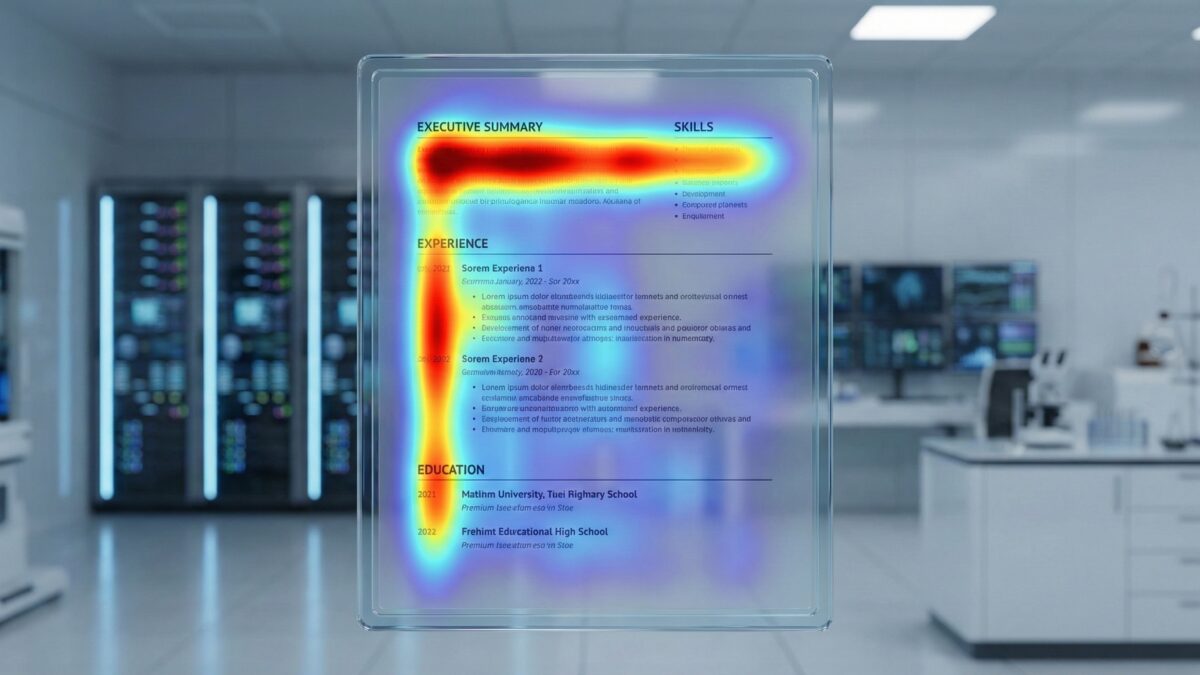
The Psychology of the “F-Pattern”
Eye-tracking studies confirm that recruiters do not read resumes top-to-bottom. They scan in an “F” shape:
- They read the Headline/Summary (Top horizontal bar).
- They scan down the left margin for Company Names & Titles (Vertical bar).
- They read the first bullet point of your most recent role (Middle horizontal bar).
If your biggest achievement is buried in bullet point #5 of a job you held four years ago, it effectively does not exist. The Zero-Fluff Protocol demands that your top 10% of value occupies the top 30% of the page.
Rule 1: Kill the “Objective” Statement
Never write: “Passionate professional looking for a challenging role in…”. This is fluff. It wastes prime real estate.
Replace it with a Executive Summary that acts as your value proposition. Use the formula: [Adjective] [Title] with [Number] years driving [Outcome] in [Industry].
Example: “Data-Driven VP of Engineering with 12+ years scaling SaaS platforms from Series B to IPO. Expert in reducing technical debt while managing distributed teams of 50+ developers.”
Rule 2: The Google “X-Y-Z” Formula for Bullet Points
Stop listing tasks (“Responsible for managing sales”). Anyone can manage sales; few can grow them. Every bullet point must follow the structure popularized by Laszlo Bock (ex-SVP of People at Google):
“Accomplished [X] as measured by [Y], by doing [Z].”

Compare the optical impact:
- 🔴 Fluff (Doer): “Improved server performance and reduced costs.”
- 🟢 Zero-Fluff (Achiever): “Reduced server latency by 40% (X) and cut AWS costs by $12k/month (Y) by migrating legacy monolithic architecture to Kubernetes microservices (Z).”
The first one is an opinion. The second one is a verifiable fact.
Rule 3: ATS Hygiene (Don’t Be Invisible)
In my years as a Tech Recruiter, I have seen brilliant candidates rejected because the robot couldn’t read their resume. Modern ATS like Greenhouse or Lever are smarter now, but they still choke on complex formatting.
The “Unsafe” List (Avoid These):
- Multi-column layouts: Often parsed incorrectly, scrambling your work history.
- Graphics/Icons for skills: If you rate your Java skills as “4 out of 5 stars,” the ATS reads nothing. Write “Java (Expert).”
- Headers/Footers: Some older parsers ignore text in header/footer regions. Keep contact info in the main body.
Rule 4: The “Tech Stack” Section (For Non-Techies Too)
Even if you are in Marketing or Finance, you have a “stack.” Do you use Salesforce? Tableau? Asana? SAP?
Create a dedicated “Skills & Tools” section at the bottom (or side, if single column). This is keyword gold for the ATS. If a job description asks for “CRM experience” and you don’t explicitly list “Salesforce,” you might not rank.
Conclusion: Your Resume is a Balance Sheet
Treat your resume like a corporate balance sheet. Your experience is the Asset. Your results are the Equity. Your fluff is the Liability.
Cut the liability. Highlight the equity. Make it impossible for the 6-second scan to miss your value.


