

Human resources managers earn a median of $149,280. Compensation and benefits managers earn $149,230. Fifty dollars apart, and one of those occupations has 224,900 jobs in the United States while the other has 23,700. Specialising into the second is a decision most people make without ever seeing the second number.
HR is usually described as a ladder: coordinator, specialist, business partner, manager, director. The federal data describes something else, a wide base that narrows into two management occupations of very different sizes, paying almost exactly the same. Which branch you climb decides how often a job exists for you to move into, and it barely touches what you earn when one does.
The ladder as the data counts it
| Occupation | Jobs, 2025 | Median wage | Change to 2035 | Openings a year |
|---|---|---|---|---|
| Human resources specialists (13-1071) | 939,700 | $75,940 | +6.4% | 73,700 |
| Training and development specialists (13-1151) | 472,500 | $69,280 | +10.8% | 46,000 |
| Human resources managers (11-3121) | 224,900 | $149,280 | +5.5% | 16,800 |
| Compensation, benefits and job analysis specialists (13-1141) | 118,100 | $78,210 | +6.0% | 9,000 |
| Compensation and benefits managers (11-3111) | 23,700 | $149,230 | +1.1% | 1,600 |
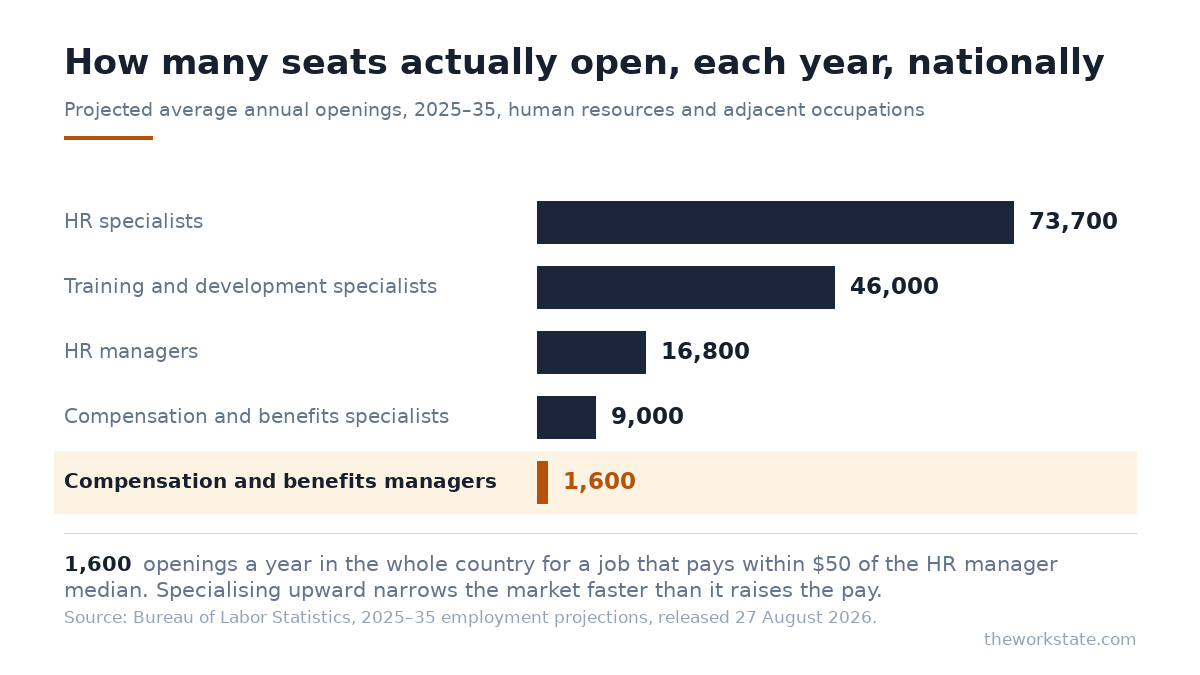
Both management occupations ask for a bachelor’s degree and five years or more of related experience. The entry cost is the same. The market you enter afterwards is not.
What 1,600 openings a year actually means
Spread across fifty states, 1,600 openings is roughly thirty a state a year, and they are not spread evenly — they concentrate wherever large employers keep their compensation function. For most people that means the job exists in a handful of metropolitan areas and nowhere else, and moving into it is a relocation decision as much as a career one.
Deep specialisation is usually sold as increasing your value. In this case the federal data says it holds your pay flat and cuts the number of doors by ninety percent.
This is not an argument against the work, which is genuinely technical and genuinely interesting. It is an argument for going in with the market size known. The total rewards manager post at Superior Construction on our board runs $110,000 to $145,000, a real job at a real employer, sitting in an occupation with about 1,600 national openings a year. If it does not work out, the next one is not around the corner.
The comparison worth holding is the HR business partner post at JPMorgan Chase at $135,000 to $165,000. Generalist HR at scale pays as well as the specialism and sits in a market ten times the size.
The branch that is actually growing
Nothing in HR grows quickly, but one adjacent occupation does: training and development specialists, projected up 10.8 percent to 2035 with 46,000 openings a year. It is the fastest-growing occupation anywhere near this field, and it pays $69,280 at the median — below HR specialists, and well below either management branch.
Those two figures are worth reading together. Fast growth and modest pay usually means an occupation absorbing work from somewhere else, and here the somewhere else is visible in the same projections: office and administrative support is projected to shed 752,100 jobs, the steepest decline of any major group. We set out which admin roles the projections cut and which they leave alone separately. Training and development is one of the few destinations those projections point toward rather than away from.
The titles with no federal series at all
Two roles on our board have no occupational code: the DEI programme manager post at Johnson & Johnson at $110,000 to $145,000, and the head of belonging post at Francis Parker School at $150,000 to $190,000.
There is no Bureau of Labor Statistics series for either, which means there is no median to negotiate against and no projection to plan around. That is a real disadvantage at offer stage, and the workaround is mechanical: price them against the management occupation whose scope they most resemble. A programme manager reporting into HR is priced against HR managers at $149,280. A school-level head with a reporting line to the head of school is an education administration post and should be priced against that institution’s other directors, not against a national figure that does not exist.
Ask which existing salary band the post was slotted into when it was created. Somebody had to choose one to get the requisition approved, and the answer tells you what the employer thinks the job is.
Before you specialise
- Look up the national size of the occupation you are moving into, not just its median wage. Pay tells you what one job is worth; openings tell you how often one exists.
- Ask whether the specialism is a department or a person. A compensation function of one is a role that disappears with a reorganisation; a team of six is a career.
- Check the geography before the title. For the smaller occupations, the honest question is which three cities the work is in.
- If the role has no federal code, establish the internal band it was created against. That is the only benchmark that exists.
- Weigh generalist scale against specialist depth on openings, not on prestige. HR business partner and total rewards manager pay comparably; only one of them has 16,800 doors a year behind it.
Human resources is a stable field with a wide base and a narrow top, and the narrowness is not evenly distributed. The wage data will tell you the two management branches are equivalent. The employment data will tell you they are not remotely equivalent, and it is the second number that determines what happens to you after the job you are currently being offered.
Employment, wage and openings figures are Bureau of Labor Statistics data for May 2025 and the 2025–35 employment projections released on 27 August 2026. Entry requirements are the bureau’s “typical entry-level education” and “work experience in a related occupation” fields. DEI and belonging roles have no separate federal occupational classification; the pricing approach described is a method, not a published benchmark.


