

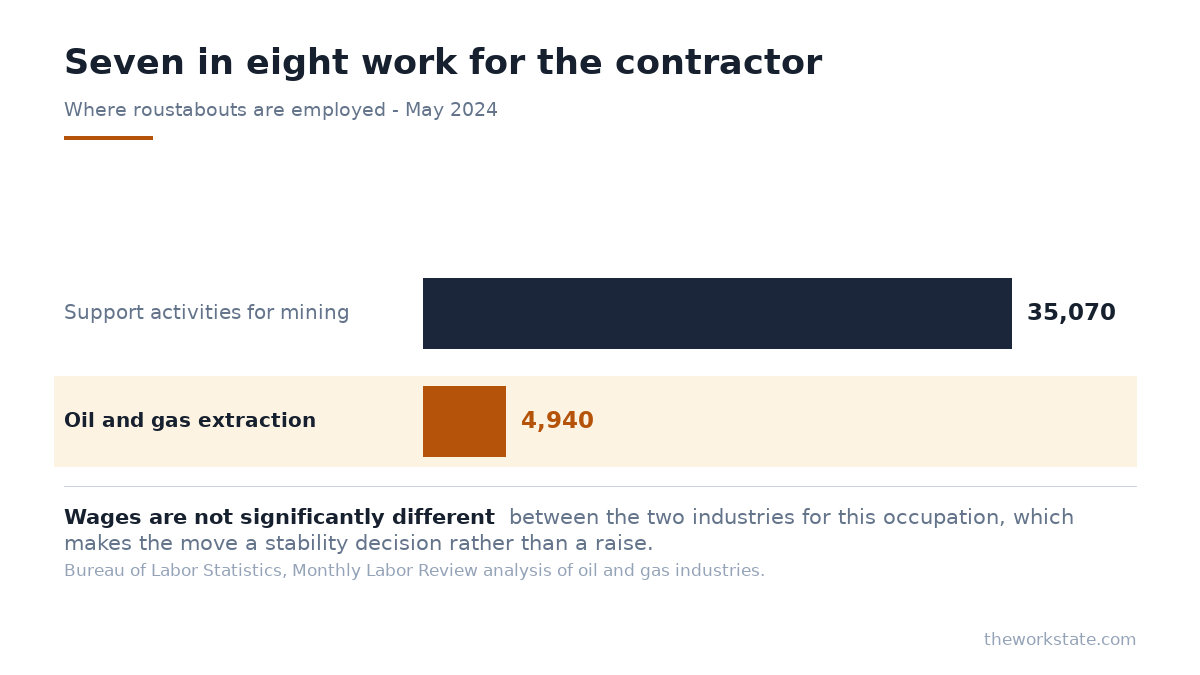
Almost nobody who works as a roustabout works for an oil company. Federal employment data puts 35,070 of them at service contractors and 4,940 at the operators themselves, roughly seven in eight are employed by someone whose name is not on the well.
That distinction shapes the job more than the job title does. It determines who schedules you, who carries your safety record, who decides whether a slow quarter ends in a transfer or a layoff. And it quietly kills the most common piece of advice given to people entering the oilfield.
Who actually signs the cheque
A roustabout is general labour on a lease or a rig: rigging up and down, moving pipe, digging and backfilling, cleaning tanks, painting, hauling, and whatever the pusher needs done that morning. It is the entry door to the oilfield, and it is one of the few remaining jobs in the United States where a person without a degree, a licence, or a trade certificate can start above the national median wage for entry-level work.
The employment split matters because the two employers are different businesses. An operator owns the production and thinks in decades. A service contractor sells crews by the day and thinks in quarters. When a basin slows, the operator idles wells; the contractor idles people. If you are counting on stability, the name on your paycheque is the single most useful thing to know before you accept.
The assumption that costs people a move
The advice you will hear on every rig and in every forum is to get on with the operator, because the operator pays better. For most oilfield occupations that is true, the Bureau of Labor Statistics found higher wages in oil and gas extraction than in support activities across the majority of jobs it measured.
Roustabouts are one of the two exceptions. In its analysis of May 2024 data, BLS reports that for oil and gas roustabouts and for rotary drill operators, wages were not significantly different between the two industries. The premium that exists for engineers, geoscientists and technicians does not appear at this rung.
Moving from a contractor to an operator for the same job title is a stability decision and a benefits decision. On base pay alone, the federal data does not support it as a raise.
That does not make the move pointless. Operator employment usually carries better health coverage, a real retirement match, and far less exposure to the contract cycle. Those are worth a great deal. They are simply not the same thing as a higher hourly rate, and people who make the move expecting the rate to jump are often disappointed by the first paycheque.
What the median hides
The figure quoted in most job ads is the median, and for this occupation the median is the least useful number available. The spread is what decides whether the job is worth the rotation.
| Percentile | Annual wage | What sits here |
|---|---|---|
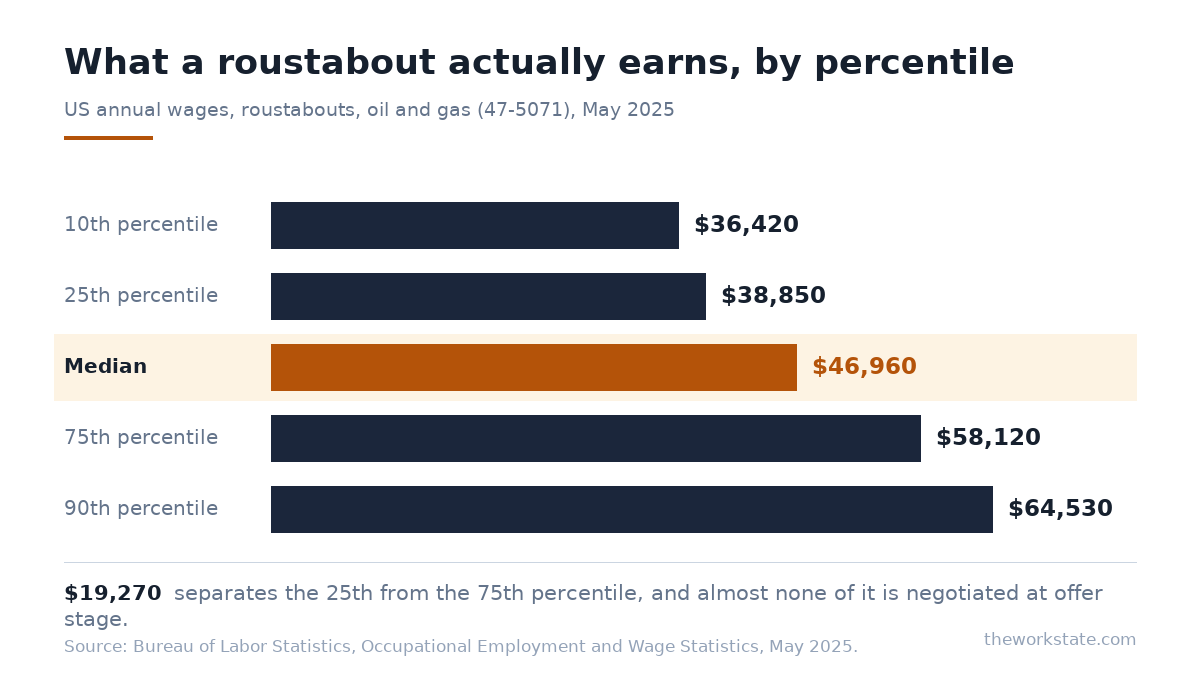
| 10th | $36,420 | Entry hand, low-activity basin, no rotation premium |
| 25th | $38,850 | First full year, standard local schedule |
| Median | $46,960 | The number the advertisement quotes |
| 75th | $58,120 | Experienced hand, rotation, overtime routine |
| 90th | $64,530 | Senior hand or lead, high-activity basin |
The gap between the 25th and 75th percentile is roughly nineteen thousand dollars for the same job title. Almost none of that is negotiated at offer stage. It is produced by three things the advertisement rarely states: how many hours the schedule actually delivers, whether the rotation pays a premium, and whether travel and lodging are covered or absorbed by you.
What a rotation does to the annual figure
Rotational schedules — fourteen days on and fourteen off is the common shape, with seven and seven and twenty-one and twenty-one also in use — change the arithmetic in ways an hourly rate does not capture. A rotation compresses a year of work into roughly half a year of days, at long shifts. That can produce a strong annual number on a modest hourly rate, or a poor one, depending entirely on the terms around it.
Three questions decide it, and all three are answerable before you sign:
- Are travel days paid? A fourteen-day hitch that costs you two unpaid days of driving is a sixteen-day hitch at a lower effective rate. Ask whether mobilisation is on the clock or on your time.
- Is per diem paid on days off? Some operators pay a daily allowance only for days worked; others cover the whole hitch. Over a year the difference runs into thousands, and it is not taxed the same way as wages.
- Is lodging provided, reimbursed, or yours? Company housing and a paid room are not the same as a mileage cheque against a motel you booked yourself.
None of these are unreasonable questions and none of them will cost you the offer. A contractor who will not answer them plainly has told you something useful.
The record you can read before the interview
Roustabout work sits in one of the more hazardous corners of American employment, and unlike pay, the safety record is public. Federal inspection history for a specific facility is searchable by name or address, and the incident rates a company reports are comparable against its own industry.
This matters more for contract work than for operator work, because a contractor’s crews rotate across sites and the site you are sent to may not be the site you interviewed about. We have written a full walkthrough of how to pull and read an industrial safety record, including what TRIR and DART actually count and how to compare a facility against its sector. OSHA also publishes standards and hazard guidance specific to oil and gas extraction, which is worth twenty minutes before a first hitch.
Before you accept
- Establish whether the employer is the operator or a service contractor, and ask directly what happens to crews when activity drops.
- Convert the offer into an annual figure using the real number of scheduled days, not a forty-hour assumption.
- Get travel, per diem and lodging in writing. They are the difference between the 25th and the 75th percentile.
- Pull the safety record for the specific facility, not the corporate name.
- Confirm which certifications the employer pays for and which you are expected to arrive holding.
The federal projections published in August 2026 put the occupation at 3.6 percent growth through 2035, with about 4,100 openings a year — steady rather than expanding. Roustabout work remains one of the few paths left where a year of willingness converts into a genuine trade. The pay ceiling is real and reachable. It simply is not reached by accepting the median and hoping the rotation makes up the difference.
Wage distribution figures are from the Bureau of Labor Statistics Occupational Employment and Wage Statistics for roustabouts, oil and gas (47-5071), May 2025. Employment counts by industry and the industry wage comparison are from the BLS Monthly Labor Review analysis of occupational employment and wages in oil and gas industries, May 2024. Rotation and allowance practices vary by operator and basin and are not set by federal rule; treat them as questions to ask, not as standards to expect.

